
Let's be honest—cloud data warehouses like Snowflake and BigQuery are brilliant products. They're fast, they scale, and they make complex analytics feel almost effortless. But here's the thing nobody talks about until the bill arrives: they're expensive as hell.
If you're running serious analytics workloads—hundreds of terabytes of data, dozens of concurrent users, complex joins across multiple sources—you've probably experienced that stomach-dropping moment when you open your monthly invoice. $50k? $100k? More? And that's just for compute and storage. Add in data egress, cross-region queries, or a few runaway queries from your data science team, and suddenly you're explaining to your CFO why the analytics budget just doubled.
There's another way. It's called Trino on dedicated hardware, and it's how companies are cutting their analytics costs by 60-80% while actually improving performance and control.
The Cloud Warehouse Pricing Trap
Snowflake and BigQuery aren't trying to rip you off (well, not exactly). Their pricing models make sense for certain use cases—sporadic queries, small datasets, teams that don't want to think about infrastructure. But when you're running production analytics at scale, the economics flip upside down.
Here's what typically happens:
Snowflake charges you for:
- Compute credits (per-second billing that adds up fast)
- Storage ($23-40/TB/month depending on region)
- Data transfer between regions or out to the internet
- Snowpipe for continuous data loading
- Search optimization, materialized views, time travel storage
A medium-sized analytics workload—let's say 100TB of data, 10 medium warehouses running 8 hours/day—can easily hit $8,000-12,000/month in compute alone. Storage adds another $2,300-4,000. Data transfer? That depends on how much you're moving, but it's never zero.
BigQuery is a bit different but no less expensive:
- On-demand queries at $6.25/TB scanned (ouch)
- Or flat-rate slots starting at $2,000/month for 100 slots
- Storage at $20-23/TB/month for active data
- Streaming inserts, BI Engine, Omni cross-cloud queries all cost extra
If your team runs a lot of exploratory queries or forgets to partition tables properly, that per-TB scanning cost becomes a runaway train. We've seen companies get $40k surprise bills because someone ran an unoptimized query against their entire dataset.
And the kicker? You don't own any of it. You're renting compute, renting storage, and paying every time data moves. There's no equity being built, no hardware you can depreciate, nothing that becomes cheaper over time.
Enter Trino: The Open-Source Alternative
Trino (formerly PrestoSQL) is a distributed SQL query engine that can query data wherever it lives—S3, HDFS, PostgreSQL, MySQL, Kafka, you name it. It was built at Facebook to query 300+ petabytes of data across disparate systems, and it's now used by companies like Netflix, Lyft, and Airbnb to run analytics at massive scale.
The beauty of Trino is that it separates compute from storage. You're not locked into a proprietary storage format or a vendor's pricing model. Your data stays where it is (or where you want it), and Trino just queries it. Fast.
But here's where it gets interesting: when you run Trino on dedicated bare metal instead of cloud VMs, the economics change completely.
The Bare Metal Advantage
Let's compare apples to apples. Say you need a Trino cluster with:
- 80 CPU cores
- 1TB RAM
- 40TB fast SSD storage
- 1Gbps network connectivity
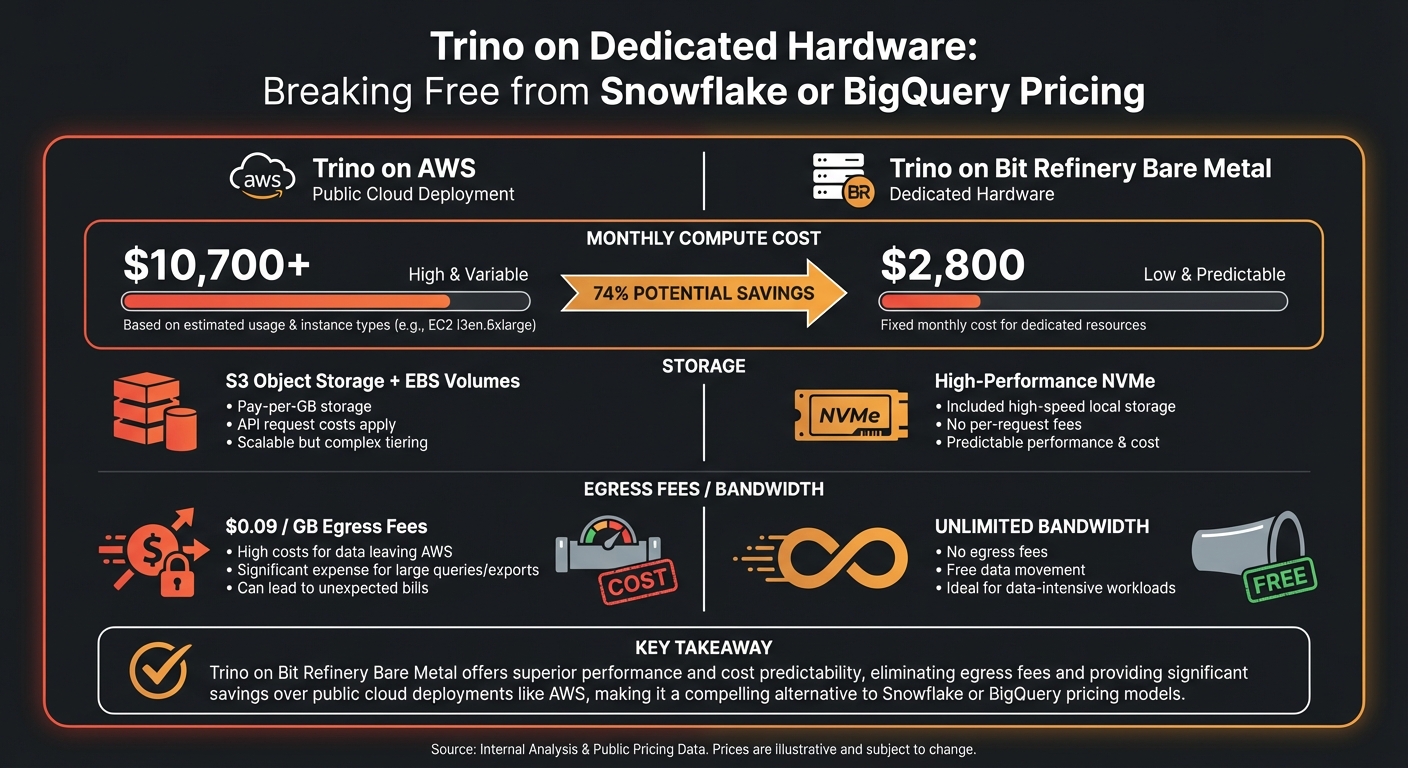
On AWS, you'd probably use r6i.metal instances (128 vCPUs, 1TB RAM) plus EBS storage. That runs about:
- Compute: ~$6,700/month (on-demand)
- Storage: ~$4,000/month (40TB gp3 SSD)
- Data transfer: $0.09/GB egress (this adds up fast)
- Total: $10,700+/month before any data movement
On Bit Refinery bare metal, you get:
- Dell PowerEdge with 80 cores, 1TB RAM, 44TB RAID6 SSD
- $2,800/month flat
- Unlimited 1Gbps bandwidth included (zero egress fees)
- 99.99% uptime SLA
- No virtualization overhead
That's a 74% cost reduction right out of the gate. And unlike cloud VMs, you're getting dedicated hardware—no noisy neighbors, no CPU throttling, no "up to" network speeds.
Now multiply that across a 5-node Trino cluster. On AWS, you're looking at $50k+/month. On bare metal? $14,000/month. Over a year, that's $432,000 in savings.
Real-World Performance Wins
Cost savings are great, but performance matters too. Here's what we've seen when customers move Trino from cloud VMs to bare metal:
1. Consistent query performance Cloud VMs share physical hardware with other tenants. When your neighbor spins up a machine learning job, your Trino queries can slow down. Bare metal eliminates that variability. Queries run in consistent time windows, which makes SLA planning actually possible.
2. Lower query latency NVMe storage on bare metal delivers 3-5x better IOPS than cloud block storage. For Trino queries that scan large datasets, this translates to 30-40% faster query completion times. Your analysts aren't waiting around, and your dashboards refresh faster.
3. Better resource utilization Without hypervisor overhead, you get 100% of your CPU and RAM for Trino. On cloud VMs, you're losing 5-10% to virtualization. That might not sound like much, but when you're paying for every vCPU, it adds up.
4. No egress fees This is the hidden killer in cloud pricing. If your Trino cluster is querying data in S3 and serving results to analysts or dashboards, you're paying egress on every byte that leaves the region. At $0.09/GB, querying 100TB/month costs an extra $9,000 in data transfer alone. Bare metal? Zero. Unlimited bandwidth included.
When Trino on Bare Metal Makes Sense
Look, we're not saying bare metal is always the answer. If you're a startup with 500GB of data and 3 users, Snowflake's free tier is probably fine. But Trino on dedicated hardware makes a ton of sense when:
- You have predictable baseline workloads. If you're running analytics 24/7 or have regular ETL jobs, you're paying for compute anyway. Might as well own it.
- Your data is measured in tens or hundreds of terabytes. At this scale, cloud storage and compute costs become painful. Bare metal flips the equation.
- You need to query multiple data sources. Trino can federate queries across S3, PostgreSQL, MySQL, Kafka, and 40+ other connectors. If your data is scattered, Trino brings it together without moving it.
- You care about cost predictability. Cloud bills fluctuate. Bare metal doesn't. You know exactly what you're paying every month.
- You want to avoid vendor lock-in. Snowflake and BigQuery use proprietary formats. Trino works with open standards. Your data stays portable.
Hybrid Approach: Own the Base, Rent the Spike
Here's the strategy we recommend to most customers: run your baseline workloads on bare metal, and burst to the cloud when you need extra capacity.
Let's say your analytics workload runs steady at 80% capacity most of the time, but spikes to 150% during end-of-quarter reporting. Instead of paying for 150% capacity 24/7 in Snowflake, you:
- Run your core Trino cluster on bare metal ($14k/month for 5 nodes)
- Spin up cloud VMs during peak periods (maybe $5k for a few days)
- Shut them down when the spike ends
Your total cost? Around $15-16k/month instead of $50k+. You're saving 70% and still getting elasticity when you need it.
Getting Started with Trino on Bare Metal
If you're thinking about making the switch, here's what the process looks like:
1. Infrastructure assessment We'll review your current Snowflake/BigQuery usage, query patterns, and data sources. This helps us right-size your Trino cluster and estimate savings.
2. Architecture design Trino works best with a coordinator node and multiple worker nodes. We'll design a cluster topology that matches your workload—whether that's 3 nodes or 20.
3. Data migration (if needed) If you're moving data out of Snowflake/BigQuery, we'll set up parallel extraction pipelines to minimize downtime. Most customers keep their data in S3 or MinIO and just point Trino at it.
4. Deployment and tuning We'll install Trino, configure connectors to your data sources, and tune JVM settings, memory allocation, and query concurrency for your specific workload.
5. Monitoring and support 24/7 monitoring with Prometheus and Grafana, automated alerts, and direct access to Trino engineers when you need help.
Typical deployment time? 2-4 weeks from kickoff to production queries.
The Bottom Line
Snowflake and BigQuery are great products, but they're not the only game in town. If you're spending $50k, $100k, or more per month on cloud analytics, Trino on dedicated bare metal can cut that bill by 60-80% while giving you better performance, zero egress fees, and full control over your infrastructure.
You're not sacrificing features or scalability. You're just choosing a different economic model—one where you own the hardware, control the costs, and build equity instead of renting forever.
Want to see what your savings would look like? We'll run a free cost comparison based on your current Snowflake or BigQuery usage. No sales pitch, just numbers.
Get a Free Trino Cost Analysis
Because let's be real—your CFO will thank you, and your data engineers will love the performance boost. It's a rare win-win.