For data engineers and CTOs, ClickHouse is often the 'magic bullet' for real-time analytics. Its ability to process billions of rows per second with sub-second latency is unmatched. However, as your data footprint grows, the infrastructure supporting ClickHouse often becomes a source of significant financial friction—especially in the public cloud.
When deploying ClickHouse on AWS (via EC2 and EBS), the initial agility is tempting. But as you scale to multi-terabyte datasets and high-concurrency query patterns, the Total Cost of Ownership (TCO) begins to spiral.
In this post, we’ll break down a three-year TCO comparison between a standard AWS deployment and Bit Refinery’s Bare Metal infrastructure.
The Hidden Levers of Cloud Costs
In the public cloud, you aren't just paying for compute. You are paying for a complex web of architectural abstractions. For a ClickHouse workload, three specific areas drive up the bill:
- Storage Throughput (IOPS): ClickHouse is a column-oriented database that relies heavily on disk I/O. To get the performance ClickHouse is capable of on AWS, you often need
io2Block Express volumes or massivegp3allocations, both of which carry heavy premiums. - Egress Fees: Data is rarely static. If you are feeding ClickHouse from external sources or serving data to global BI tools, AWS egress fees ($0.05–$0.09/GB) act as a 'success tax' on your growth.
- The Virtualization Tax: Hypervisors introduce jitter and overhead. To achieve the same performance as a dedicated physical CPU, you often have to over-provision instances, paying for 'ghost' resources you don't actually control.
The Comparison: 100TB Analytics Cluster
Let's look at a typical production scenario: A ClickHouse cluster requiring high performance, 1TB of RAM, and roughly 40-50TB of usable SSD storage (RAID 6/10 for redundancy).
Scenario A: AWS (r6i.metal + EBS)
- Instance:
r6i.metal(128 vCPUs, 1TB RAM) - Storage: 44TB of
gp3storage with provisioned throughput. - Monthly Compute/Storage: ~$10,658
- Data Transfer: Assuming a modest 20TB of egress/month (~$1,800).
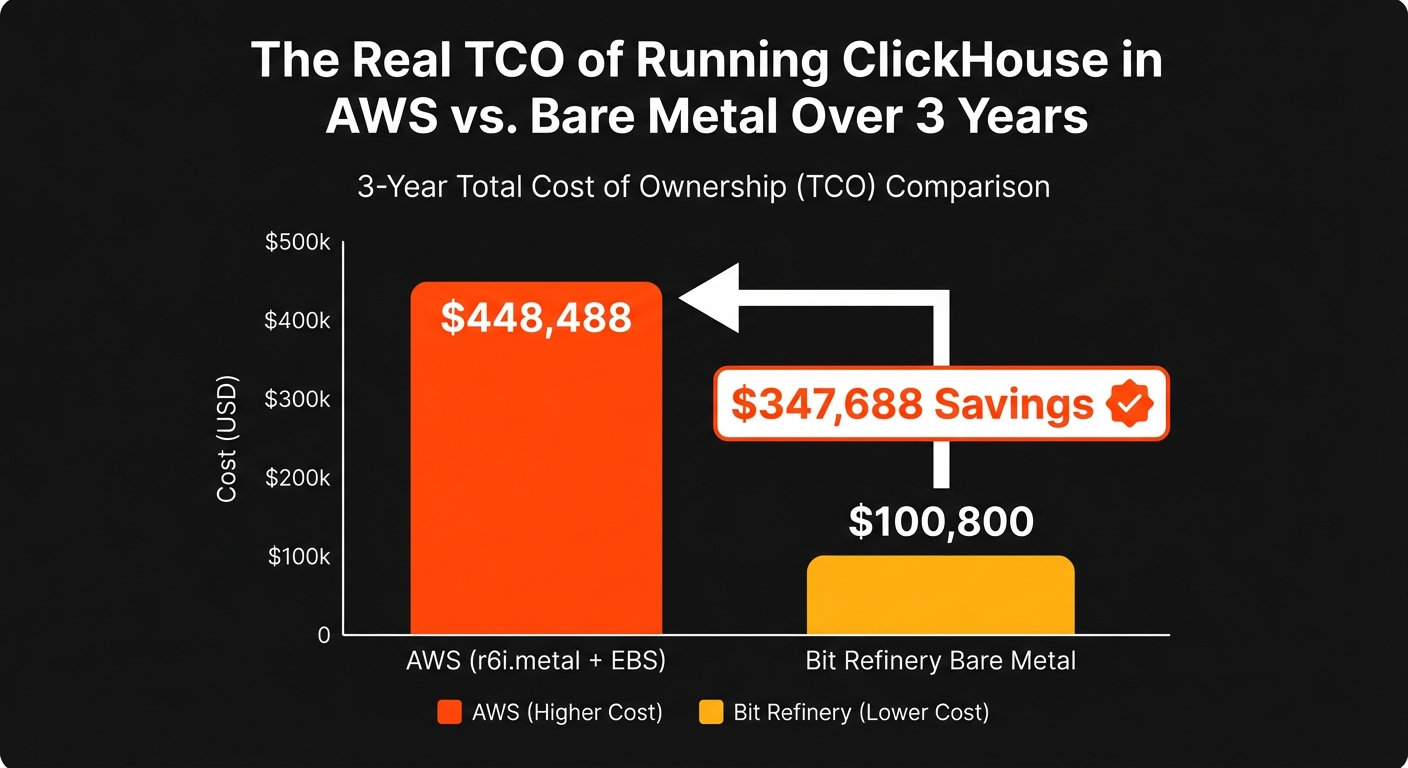
- 3-Year Total: ~$448,488 (excluding inevitable scaling and snapshot costs).
Scenario B: Bit Refinery (Gold Tier Bare Metal)
- Server: Bit Refinery Gold (80 Physical Cores, 1TB RAM)
- Storage: 44TB RAID6 Enterprise SSD (Included)
- Bandwidth: Unlimited 1 Gbps ($0 Egress)
- Monthly Cost: $2,800
- 3-Year Total: $100,800
The Difference: Over three years, the bare metal approach saves $347,688—a 77% reduction in infrastructure spend for the exact same (or better) performance profile.
Performance: Why Bare Metal Wins for ClickHouse
ClickHouse thrives when it has direct access to the hardware. In a bare metal environment, there is no noisy neighbor effect. When ClickHouse executes a parallel scan across 80 cores, it isn't competing with another tenant's microservices for CPU cycles.
Direct NVMe Access
On Bit Refinery's hardware, your data sits on enterprise-grade SSDs connected via high-performance RAID controllers or direct NVMe. In the cloud, your data often travels over a network-attached storage (EBS) fabric. Even with high-speed Nitro cards, network-attached storage cannot match the sub-millisecond latency of local, physical disks. For ClickHouse, lower latency translates directly to faster query response times for your end-users.
"Own the Base, Rent the Spike"
At Bit Refinery, we advocate for a hybrid philosophy. Use bare metal for your baseline data workloads—the 24/7 ingestion and heavy lifting where performance and cost predictability are paramount. If you have seasonal spikes or need ephemeral dev environments, use the public cloud for those "spikes."
Beyond the Hardware: Managed Services
Saving money on hardware is only half the battle. Running ClickHouse at scale requires expertise in shard distribution, MergeTree engine tuning, and Zookeeper/Keeper management.
Bit Refinery, in partnership with Quantrail Data, offers managed ClickHouse services. We don't just give you the keys to a server; we provide:
- Architecture Design: Ensuring your schema is optimized for columnar storage.
- Migration Support: Moving data from AWS S3 or Snowflake into ClickHouse with zero downtime.
- 24/7 Monitoring: Proactive alerts on disk pressure, query bottlenecks, and hardware health.
Conclusion
If your ClickHouse bill is starting to rival your payroll, it’s time to look under the hood. The "Cloud First" mandate of the last decade is being replaced by a "Performance First" reality. For data-intensive applications, bare metal isn't just a legacy choice—it's the modern choice for those who value performance, predictability, and the bottom line.
Ready to audit your ClickHouse spend? Contact Bit Refinery today for a custom TCO analysis and see how much you could save by moving to bare metal.