
Every few weeks somebody asks us a version of the same question: is air cooling finished? The trade press has been running the funeral for a while now, and the growth numbers behind liquid cooling are real. But walk any working data hall, ours included, and you'll find both. Often in the same row, doing different jobs.
Here's what we cover below:
- What air cooling still does well, and why it isn't going anywhere
- The point where air stops making sense, and how to spot it in your own racks
- What liquid actually buys you, and what it costs you in return
- Where we draw the line ourselves
1. Air cooling earns its place through simplicity
Air cooling has one enormous advantage that never shows up in a vendor deck: nothing leaks. A raised floor, a hot aisle, a row of computer room air conditioners, and a tech who can swap a fan tray at two in the morning without filing a work permit. We've run rooms this way for seventeen years and most of that gear is still doing its job.
For racks in the 5 to 15 kW range, which is still where most enterprise compute lives, air is usually the right answer. Web servers, database nodes, virtualization hosts, backup targets, network gear. None of it is thermally interesting. Cooling that with water adds cost and risk for no gain.
Air also wins on speed of change. You can move a rack, add a rack, or pull one out without touching a coolant loop or draining anything.
2. Where air runs out of room
The limit isn't really a temperature. It's a volume of moving air, and the fan power it takes to move it.
Push a rack past roughly 20 kW and the fans start eating your budget twice over. They draw more power themselves, and past a certain speed they're adding heat about as fast as the extra airflow carries it off. In most rooms we've seen, the practical ceiling lands between 15 and 25 kW, depending on the containment and on how disciplined the room is about blanking panels. (Want a quick read on any data hall? Look at the blanking panels. They'll tell you more about the operator than the tour will.)
Then the accelerators showed up. One modern training node pulls 6 to 10 kW on its own. Stack a few and you're past 40 kW before the rack is half full. At that density air doesn't just get inefficient, it quits. The chips throttle, and hardware you paid a lot for delivers a fraction of what it should.
Three signs a room is hitting its air limit:
- Inlet temperatures that swing more than a few degrees between the bottom and the top of the same rack
- Nodes reporting fan power as a rising share of total node power
- Half empty racks that can't take another server because the cooling is full, not the power feed
That third one is the expensive one. You're paying rent on floor space you can't fill.
3. What liquid buys you
Water moves heat roughly three thousand times better than air by volume. Everything else follows from that one number.
Density. Cold plates sitting right on the processors let you fill a rack the way the power feed allows instead of the way the airflow allows. Racks at 60 to 130 kW are ordinary now, and the roadmaps go higher.
Efficiency. Most of the server fans go away, and so does much of the room level air handling. The facility loop can often reject heat with dry coolers instead of compressors for a good part of the year.
Steadier silicon. A liquid cooled row is calmer to work in, and the chips hold their boost clocks instead of sawing up and down against a thermal ceiling. On a long training run that shows up directly in throughput.
Heat worth reusing. Water leaving a rack at 45 to 60 degrees Celsius is useful. Air carrying the same energy isn't.
4. What liquid costs you
We'd be doing you a disservice if we skipped this part.
Liquid cooling brings plumbing into a room designed to keep water out. Quick disconnect fittings, leak detection, a coolant distribution unit, fluid chemistry somebody has to test and top up. Capital cost is higher, vendor lock is tighter, and far fewer people can service it at 3 a.m.
So we put it where it pays for itself, and nowhere else.
5. The comparison, side by side
| Air cooled | Liquid cooled | |
|---|---|---|
| Typical rack density | 5 to 15 kW | 40 to 130 kW |
| Capital cost | Low | High |
| Cooling overhead | Significant, fans plus room handling | Much lower, pumps only |
| Failure mode | Gradual, thermal throttling | Abrupt, leaks and pump loss |
| Heat reuse | Impractical | Practical |
| Best fit | General compute, storage, network, edge | GPU training and inference, HPC |
| Time to deploy | Days | Weeks to months |
6. Most real rooms are hybrid, and stay that way
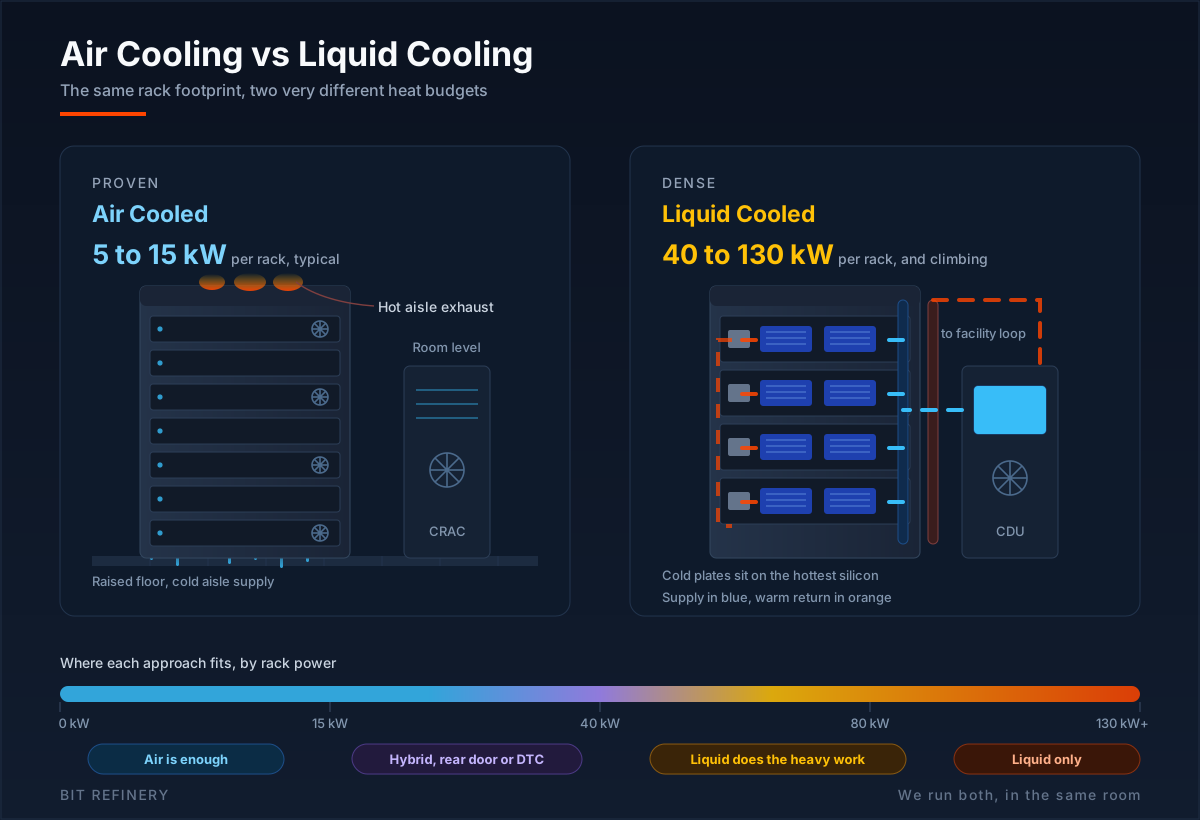
The design question worth arguing about is where you draw the line inside a single room.
Below about 20 kW per rack, air. Above about 40 kW, liquid. In between sits a middle ground that gets ignored too often: rear door heat exchangers, which bolt a water cooled radiator onto the back of an otherwise normal rack, and direct to chip cold plates that take the processors while air handles everything else in the chassis. Both let you lift density without converting the whole hall.
It's also how most operators will get from here to there. Very few of us are building a new hall from scratch. We're adding accelerated compute to rooms that already have paying tenants, and they don't want their storage nodes rearranged so somebody else can train a model.
One widely circulated projection puts the liquid cooling market at roughly 4 billion dollars in 2026 and nearly 28 billion by 2033. Treat that precision with suspicion, but the direction isn't in doubt.
7. Where we draw the line
At Bit Refinery we run both, deliberately.
General purpose infrastructure, so the VergeOS hosts, MinIO storage nodes, database servers and Juniper gear, runs air cooled in contained hot aisles across our Denver and Seattle floors. Proven, serviceable at any hour, and the density doesn't justify anything else.
GPU capacity is a different animal. Those nodes get liquid, because the alternative is throttled silicon and half empty racks, and customers buying GPU time pay for sustained throughput rather than a peak benchmark.
If you're working out where your own line sits, start with two numbers: measured power per rack today, and your honest guess at rack density two years out. If that second number lands above 30 kW, price rear door heat exchangers now, while the room is still yours to plan around. Retrofitting a hall full of paying tenants costs far more. We're happy to walk through that math with you, whether you end up hosting with us or not.