
The enterprise virtualization landscape has shifted seismically over the last 24 months. What was once a stable, predictable line item in the IT budget—the VMware stack—has transformed into what many CTOs and DevOps engineers now call the "vTax."
Between radical changes in licensing structures, the mandatory bundling of products, and a pivot away from perpetual licenses toward steep subscription models, the cost of staying on legacy virtualization platforms is no longer just a financial burden; it’s a technical bottleneck. For data-intensive workloads involving ClickHouse, Trino, or AI model training, the overhead of traditional hypervisors combined with unpredictable pricing is driving a mass migration toward more efficient, modern alternatives.
As we look toward 2026, the goal isn't just to find a "cheaper VMware." The goal is to build a more resilient, high-performance infrastructure that bridges the gap between the flexibility of the cloud and the raw power of bare metal.
The Hidden Costs of the Legacy Hypervisor
When we talk about the "vTax," we aren't just talking about the invoice from the vendor. We’re talking about the cumulative inefficiency of legacy virtualization:
- The Resource Tax: Traditional hypervisors can consume 10-15% of your CPU and RAM just to keep the lights on. For a cluster running 80-core Gold tier servers, that’s 8-12 cores per node lost to the "middleman."
- The Complexity Tax: Managing separate silos for compute (ESXi), storage (vSAN), and networking (NSX) requires specialized teams and complex integration.
- The Egress Tax: If you’ve moved these workloads to a hyperscale public cloud to escape hardware management, you're now trapped by data movement fees that can exceed your compute costs.
The Alternative: Ultraconverged Virtualization with VergeOS
At Bit Refinery, we’ve seen a surge in interest for VergeOS, an ultraconverged virtualization platform that serves as a modern, streamlined alternative to the VMware ecosystem. Unlike legacy stacks that bolt together disparate products, VergeOS is a single piece of software that handles compute, storage, and networking.
Why it’s Winning in 2026:
- Efficiency: Because it’s a unified kernel, the overhead is significantly lower than traditional stacks. This allows for higher VM density on the same hardware—or more power for your data-heavy applications.
- Predictable Licensing: One of the biggest pain points of the current market is per-core or per-VM pricing that punishes you for scaling. VergeOS utilizes a per-node licensing model. If you upgrade your CPU from 48 to 80 cores, your software cost doesn't double.
- Native SDN and Storage: Software-defined networking (SDN) is built-in, not a separate, expensive add-on. You get nested multi-tenancy and instant snapshots at the environment level, which is a game-changer for DevOps pipelines.
The "Own the Base" Strategy
For many of our customers in finance, ad tech, and healthcare, the most effective way to escape the vTax is a hybrid approach we call "Own the Base, Rent the Spike."
Instead of running 100% of your predictable, data-intensive workloads in a variable-cost public cloud, you move your baseline operations to dedicated bare-metal servers or private virtualized clusters.
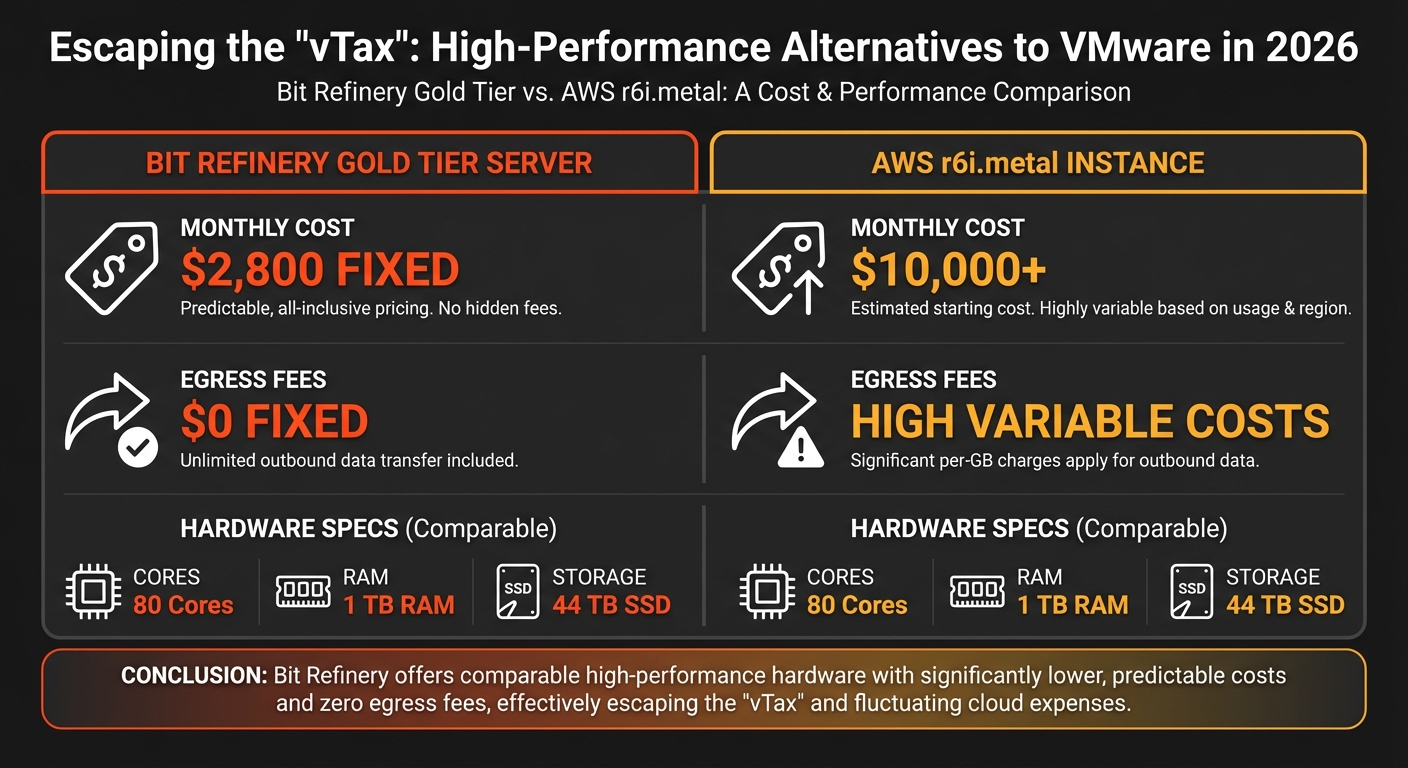
For example, a Bit Refinery Gold Tier server provides:
- 80 Cores / 1 TB RAM
- 44 TB RAID6 SSD
- $0 Egress Fees
- Total: $2,800/mo
A comparable configuration on AWS (such as an r6i.metal instance) can easily exceed $10,000/month before you even account for the massive egress fees associated with high-scale data analytics.
Modernizing the Data Stack: ClickHouse and Trino
Escaping the vTax also means modernizing how you process data. If you are migrating away from legacy virtualization, it's the perfect time to audit your data architecture.
Many organizations find that by moving to ClickHouse for real-time analytics or Trino for federated queries, they can significantly reduce the number of VMs required. When these tools are deployed on bare metal or highly efficient VergeOS nodes, the performance gains are often 10x to 100x compared to running them on top of a bloated, legacy hypervisor.
The Migration Path: It’s Easier Than You Think
The biggest fear regarding a VMware exit is the migration itself. However, modern tooling has matured significantly. Our migration process at Bit Refinery involves:
- Infrastructure Audit: Mapping current resource utilization to ensure you aren't over-provisioning in the new environment.
- Automated Conversion: Using tool-assisted VM conversion to move workloads from vSphere/ESXi to VergeOS with minimal downtime.
- Network Re-mapping: Handling the transition of VLAN topologies and security groups within the native VergeOS SDN.
- Validation: Running parallel environments to ensure performance benchmarks are met before the final cutover.
Conclusion: The Future is Lean
By 2026, the "vTax" will likely be a prohibitive cost for any company operating at scale. The shift toward bare-metal performance, ultraconverged virtualization, and predictable monthly pricing isn't just a trend—it's a necessity for maintaining a competitive edge in a data-driven economy.
Whether you are looking to colocate your own GPU hardware to save 60% on AI training costs or looking for a managed VergeOS environment to replace a ballooning VMware contract, the path forward is clear: simplify the stack, own your hardware baseline, and stop paying for overhead you don't need.
Ready to see how much you can save by moving off legacy virtualization? Contact the Bit Refinery team for a custom infrastructure audit and migration roadmap.