In the world of high-frequency trading (HFT) and real-time financial analytics, the difference between a profitable trade and a missed opportunity is measured in microseconds. For CTOs and engineers building these systems, the primary challenge isn't just speed—it is determinism.
Deterministic performance means that a system responds within a predictable time window, every single time. In a public cloud environment, this is nearly impossible to achieve due to virtualization overhead and the 'noisy neighbor' effect. When your application shares a physical CPU with a dozen other tenants, CPU pinning and cache locality become suggestions rather than guarantees.
At Bit Refinery, we work with fintech firms to move away from the unpredictability of hyperscale clouds toward a 'bare metal first' strategy that prioritizes raw performance and low-latency networking.
The Problem with Virtualization in Fintech
Standard cloud instances rely on a hypervisor to manage resources. While modern hypervisors are efficient, they introduce several layers of abstraction that are detrimental to high-frequency applications:
- Interrupt Latency: The hypervisor must intercept hardware interrupts before passing them to the guest OS, adding nanoseconds that aggregate into milliseconds of 'jitter.'
- Steal Time: If another VM on the same host spikes in activity, your process may be de-scheduled from the CPU, leading to unpredictable execution times.
- TLB Misses and Cache Contention: Shared L3 caches mean that another tenant's memory-intensive workload can flush your application's hot data out of the cache.
For a fintech application calculating risk or executing a buy order, these variables create a 'long tail' of latency (P99.9) that can break execution logic or lead to slippage.
The Bare Metal Advantage
By moving to bare metal infrastructure—like our Gold or Platinum tiers—engineers gain direct access to the silicon. This allows for low-level optimizations that are simply unavailable in the public cloud:
- Core Isolation and Affinity: You can pin critical execution threads to specific physical cores, ensuring that your most sensitive logic never leaves the L1/L2 cache of a specific processor.
- Non-Uniform Memory Access (NUMA) Tuning: In multi-socket systems (like our 80-core Gold servers), ensuring that a process running on Socket 0 only accesses memory directly attached to Socket 0 is vital for reducing memory latency.
- Direct Hardware Access: Using SR-IOV or bypassing the kernel entirely with DPDK (Data Plane Development Kit) allows your application to talk directly to the network interface card (NIC), bypassing the standard Linux networking stack to achieve sub-microsecond packet processing.
Real-Time Analytics at Scale: ClickHouse and Trino
Deterministic performance isn't just for the execution engine; it’s also for the data layer. Fintech firms generate terabytes of tick data daily. Analyzing this data for pattern recognition or regulatory compliance requires a stack that doesn't choke under load.
ClickHouse for Tick Data
ClickHouse is the gold standard for real-time OLAP in finance. When deployed on bare metal with NVMe storage, ClickHouse can process hundreds of millions of rows per second. Bit Refinery’s managed ClickHouse service ensures that your data is stored on dedicated hardware with $0 egress fees, allowing you to pipe massive amounts of market data into your environment without the 'cloud tax' associated with AWS or GCP.
Trino for Federated Queries
Often, financial data is siloed across different buckets—S3-compatible storage for historical logs, PostgreSQL for user metadata, and ClickHouse for market data. Trino allows you to query across these sources using standard SQL. By running Trino on high-memory bare metal (up to 3 TB DDR5), you ensure that complex joins happen in-memory, providing the speed required for real-time fraud detection and risk modeling.
Infrastructure as a Competitive Moat
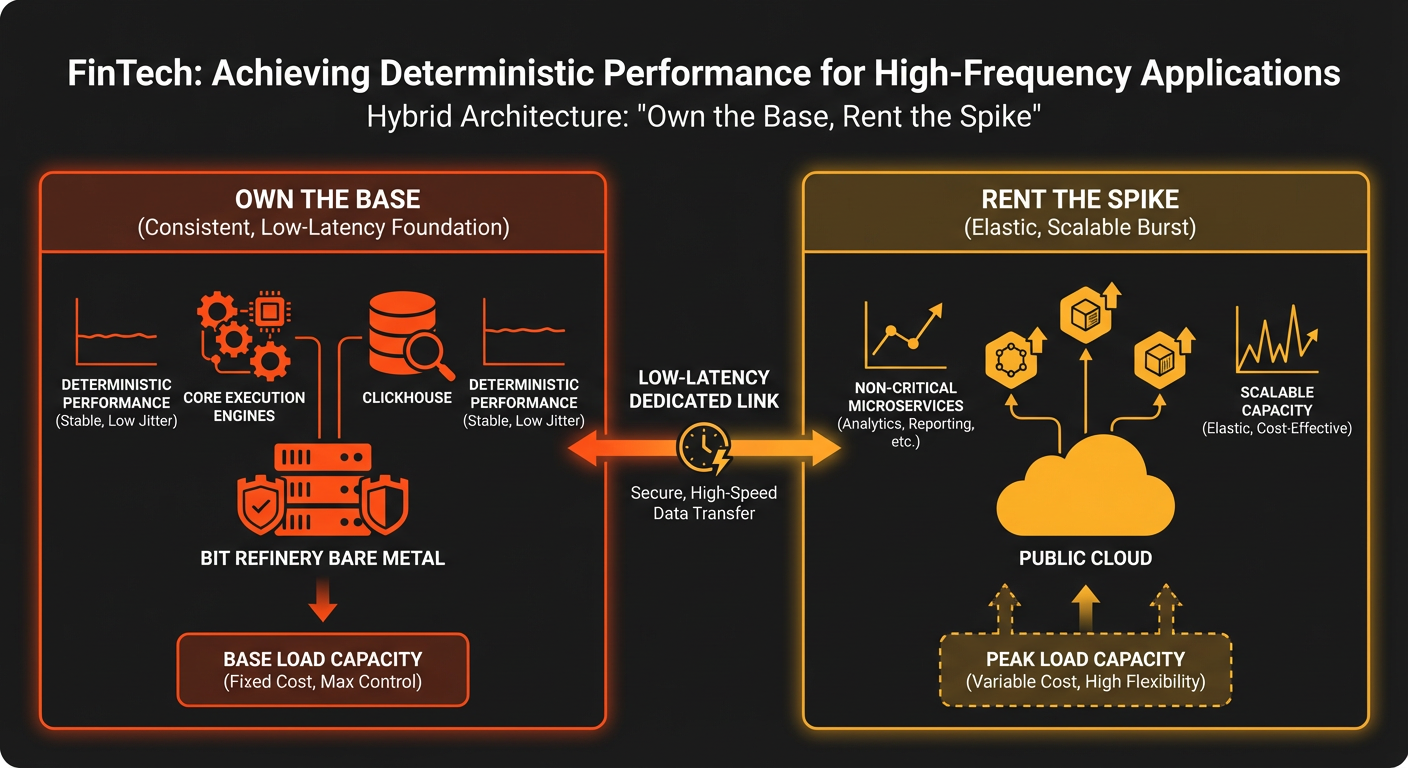
Many fintech startups begin on AWS for the ease of entry. However, as they scale, the cost of variable performance and high egress fees becomes a liability. A common architecture we see is the "Own the Base, Rent the Spike" model:
- The Base: Core execution engines, real-time databases (ClickHouse), and sensitive proprietary algorithms run on Bit Refinery Bare Metal in our Denver or Seattle facilities. This provides the 99.99% uptime and deterministic latency required for core operations.
- The Spike: Non-critical microservices or batch processing jobs can scale into public cloud resources during peak market volatility, connected via our sub-2ms low-latency links to major cloud providers.
Conclusion
In fintech, latency is a cost. By eliminating the hypervisor and moving to a dedicated, high-performance hardware stack, firms can reclaim control over their application's performance profile.
Whether you are shiping your own H100s for AI-driven quantitative analysis through our BYOGPU program or migrating a massive VMware environment to VergeOS, the goal remains the same: predictable, high-speed, and cost-effective infrastructure.