If you missed the announcement, Google Cloud quietly doubled their peering egress rates effective May 2026. Not a 10% bump. Not a "we're adjusting for inflation" kind of thing. Double. And if you're running any kind of data-intensive workload on GCP — analytics pipelines, ML training jobs, media delivery, anything that moves serious data — this is the kind of change that shows up hard on your monthly bill.
Let's actually look at the numbers, because I think a lot of teams haven't done this math yet.
What GCP Egress Actually Costs Now
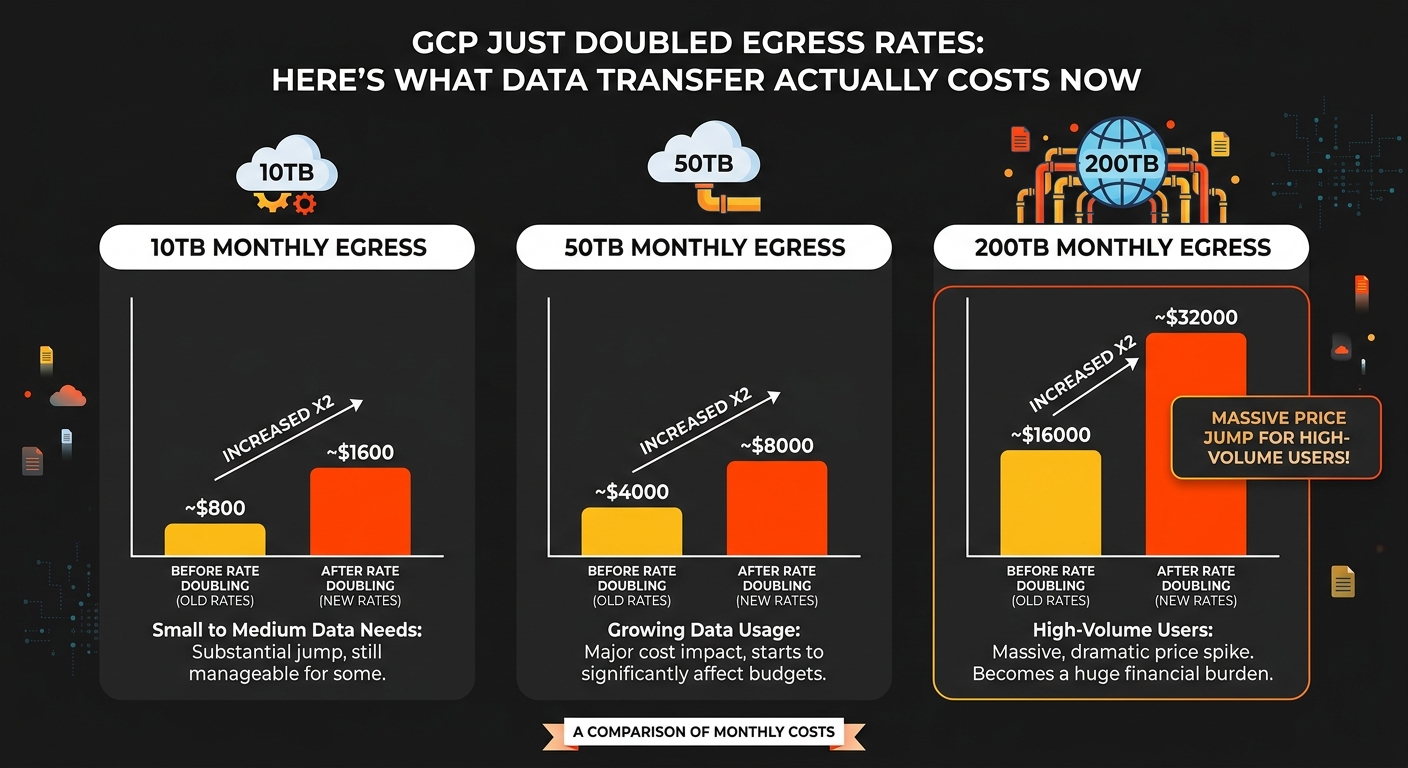
Before the rate change, internet egress from GCP ran roughly $0.08–$0.12/GB depending on destination and volume tiers. After May 2026, peering egress — the traffic that flows through Google's direct peering relationships with ISPs and networks — has effectively doubled in cost for many configurations.
Here's what that looks like in practice:
- 10 TB/month egress: Was ~$800. Now closer to $1,600+.
- 50 TB/month egress: Was ~$3,500. Now you're looking at $7,000+.
- 200 TB/month egress: This is where it gets genuinely painful. We're talking $25,000–$30,000 per month just in egress fees.
And that's before you factor in inter-region transfer costs, cross-zone traffic, or any of the other ways GCP (and honestly every hyperscaler) finds to charge you for moving your own data around.
The thing that gets me about egress pricing is how normalized it's become. Teams just... absorb it. It shows up as a line item, finance asks about it once, and then everyone shrugs and moves on. But when rates double overnight, suddenly that shrug gets a lot more expensive.
Why Private Interconnects Change Everything
Here's where the math gets interesting. Private peering connections — dedicated physical links between your infrastructure and GCP — have always been the "right" answer for high-volume data transfer. The problem is they've also always been expensive to set up and maintain.
AWS Direct Connect runs $1,500–$2,250/month just for the port. Azure ExpressRoute? $5,000–$8,000/month. GCP Partner Interconnect through a standard provider is $1,700+/month. And that's before you're actually moving any data — those are just the connection fees.
So most teams do the math, decide it's not worth it unless they're moving truly massive volumes, and go back to paying internet egress rates. Which was already a bad deal. And now it's twice as bad.
The Free Interconnect Option Nobody's Talking About
We include a free Google Cloud Interconnect with every server at our Denver facility. No port fees, no cross-connect charges, no monthly interconnect bill. Just a dedicated physical link to GCP.
I want to be direct about what that actually means for the egress math:
Data flowing from bare metal into GCP costs $0 on both sides. Zero egress from our infrastructure, zero ingress charges from Google.
Data coming back from GCP to bare metal runs about $0.02/GB — that's the GCP-side charge for traffic over the interconnect. Compare that to $0.08–$0.23/GB for standard internet egress. We're talking 75–90% reduction.
Sub-millisecond latency over a dedicated physical link, not a VPN tunnel or some internet-based connection that's going to add jitter to your queries.
And it works with basically everything in GCP that supports Private Google Access — BigQuery, Cloud Storage, Vertex AI, GKE, Compute Engine, Cloud SQL, Cloud CDN. If you're running a hybrid architecture that touches any of those services, this matters.
Real Architectures That Benefit From This
Let me sketch out a few patterns where this actually makes a difference.
Analytics and data warehouse pipelines. Run ClickHouse or Trino on bare metal for your hot query layer — fast NVMe storage, no virtualization overhead, predictable performance. BigQuery handles the cold archival and ad-hoc exploration. Data flows between them over the interconnect at $0.02/GB instead of $0.15+/GB. For a team moving 20 TB/month between those layers, that's a $2,600/month swing.
AI/ML training and serving. This one's huge right now. Training runs on your own GPUs (or colocated hardware through our BYOGPU program), and inference serving lives in Vertex AI where you can scale to zero between jobs. The interconnect means your training data doesn't cost a fortune to push into GCP for serving, and your model outputs come back cheaply. The economics of hybrid AI infrastructure finally make sense when you're not paying cloud egress rates on every data movement.
Disaster recovery. VergeOS replication to GCE failover targets is a genuinely solid DR architecture. The interconnect makes the replication traffic cheap enough that you can actually replicate at reasonable frequency without the egress costs eating your DR budget.
Media and content delivery. MinIO on bare metal as your origin store, Google CDN for delivery. Your origin-to-CDN transfer happens over the interconnect. This is one of those cases where the savings can be immediate and dramatic — media companies move a lot of data.
The "Own the Base, Rent the Spike" Model
The core philosophy here is pretty simple: dedicated hardware for your baseline workload, cloud resources for genuine demand spikes. It's not anti-cloud — it's just honest about where cloud pricing makes sense and where it doesn't.
Cloud is genuinely great for variable, unpredictable workloads. Burst capacity, geographic distribution, managed services you don't want to operate yourself. Nobody's arguing against that.
But if you have a predictable baseline — a ClickHouse cluster that's running 24/7, GPU training jobs that run on a schedule, an analytics database that your BI tools are always hitting — paying cloud rates for that baseline is just expensive. Our Gold tier (80 cores, 1 TB RAM, 44 TB NVMe in RAID6) is $2,800/month. A comparable AWS configuration runs over $10,000/month, and that's before egress.
The free GCP interconnect is what makes the hybrid model actually work in practice. Without it, you're saving on compute but paying on data movement, and depending on your workload, that can eat most of the savings. With it, the data movement piece is basically free in one direction and nearly free in the other.
What To Do If You're Feeling the Rate Increase
Honestly, the first thing is just to actually measure your egress. Pull your GCP billing export into BigQuery (the irony) and look at what you're spending on data transfer by service and destination. A lot of teams are surprised by what they find — egress from Cloud Storage to internet is different from Cloud SQL to internet is different from GKE pod traffic, and they all have different rates.
Once you know where the egress is coming from, you can figure out which workloads make sense to move to a hybrid model. Not everything does — that's fine. But the workloads with high, predictable data movement between GCP and your own infrastructure are exactly the ones where a free private interconnect pays for itself immediately.
If you want to talk through the architecture, we're happy to do that. No sales pressure, just an honest conversation about whether the numbers work for your situation. Sometimes they do, sometimes they don't — but with egress rates where they are now, it's worth doing the math.