In the early days of the cloud migration gold rush, the pitch was simple: agility, scalability, and pay-as-you-go pricing. But as enterprise data footprints have grown from gigabytes to petabytes, many CTOs and data engineers are discovering a sobering reality. The public cloud often functions like the legendary Hotel California: You can check out any time you like, but you can never leave.
This isn't just about brand loyalty; it's about a calculated architectural and financial phenomenon known as Cloud Lock-in, driven primarily by the high cost and technical friction of data egress.
The Ingestion Bait-and-Switch
If you want to move 100TB of data into a hyperscale cloud provider (AWS, Azure, or GCP), the red carpet is rolled out. Inbound data transfer (ingress) is almost universally free. They provide specialized tools like AWS Snowball or Azure Data Box to physically ship your drives to their data centers.
However, the moment that data needs to move out—whether it’s to a different cloud provider, back to an on-premises facility, or even to a specialized bare-metal provider—the financial gates slam shut.
The Math of Egress Fees
Standard egress rates across the "Big Three" typically hover between $0.05 and $0.09 per GB. At first glance, this looks like a rounding error. But let’s look at the scale of a modern data-intensive organization:
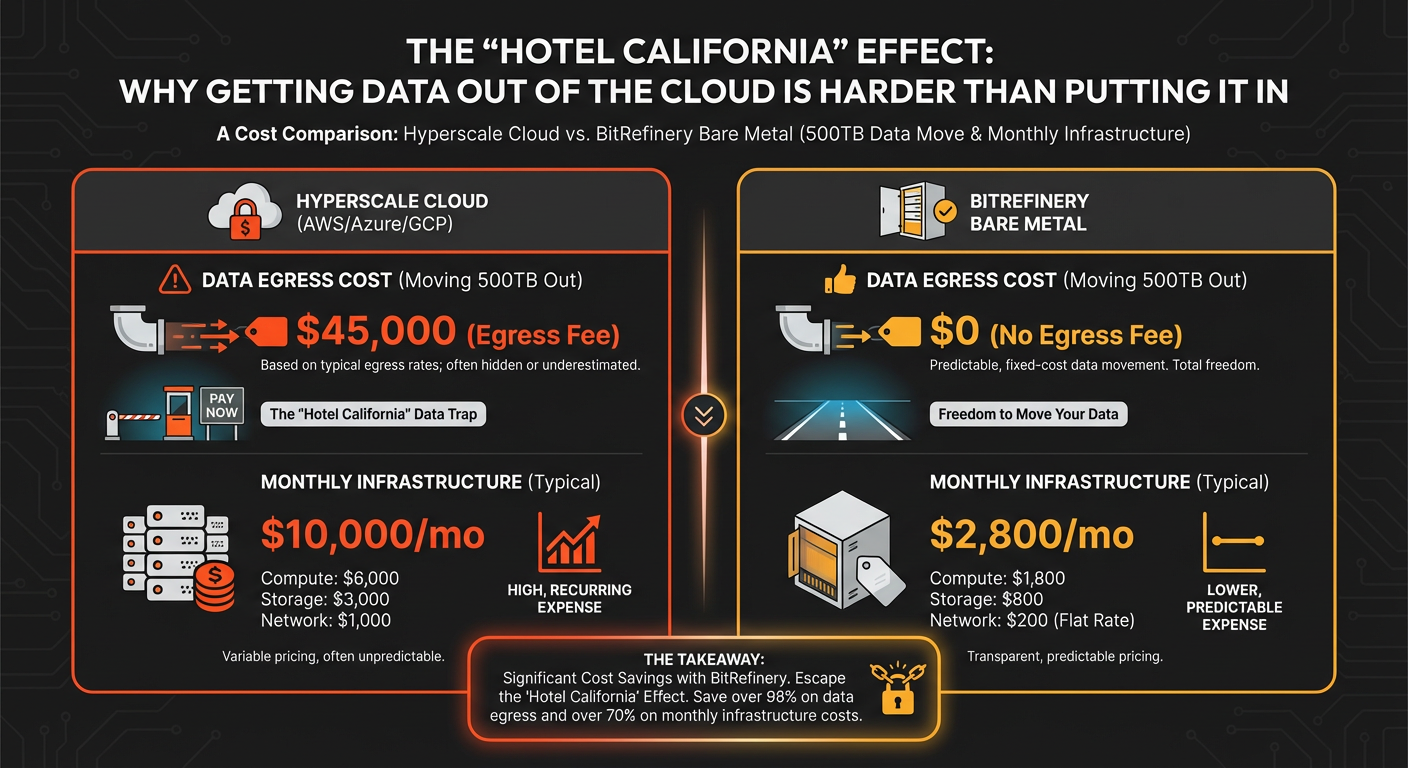
- The 500TB Scenario: If you have a 500TB data lake and decide to migrate or simply need to replicate that data for a multi-cloud strategy, you are looking at an egress bill of approximately $40,000 to $45,000 just for the privilege of moving your own bits across the wire.
- The Recurring Tax: This isn't just a one-time migration issue. If your application architecture involves frequent data movement—such as pulling large datasets for local AI model training or distributing media assets—you are paying a recurring "tax" on your own productivity.
Technical Friction: Beyond the Bill
While the financial cost is the most visible barrier, the technical hurdles are equally daunting. Hyperscalers have built deep ecosystems of proprietary APIs and services that create "gravity."
- Proprietary Storage Formats: While many services claim to be open, the way data is indexed, tiered, and managed within proprietary object stores or managed databases makes a clean break difficult.
- Network Throughput Throttling: Moving massive amounts of data out often hits performance bottlenecks. Without dedicated (and expensive) direct connect circuits, trying to move petabytes over standard internet gateways can take weeks, during which your data is effectively "stuck."
- The Metadata Trap: It’s not just the raw data; it’s the permissions, tags, and lifecycle policies. Rebuilding this logic in a new environment is a massive engineering undertaking.
Breaking the Cycle: "Own the Base, Rent the Spike"
At BitRefinery, we advocate for a different philosophy: Own the Base, Rent the Spike.
Most organizations have a predictable baseline of data processing and storage needs. When you put that baseline on hyperscale cloud infrastructure, you aren't just paying for the hardware; you're paying for the convenience of scaling—even when you aren't scaling. You are also paying for the risk that you might one day want to move.
The Bare Metal Alternative
By moving data-intensive workloads—like ClickHouse analytics, Trino query engines, or large-scale MinIO object storage—to bare-metal infrastructure, you regain control over your data destiny.
- $0 Egress Fees: At BitRefinery, we provide unlimited 1 Gbps bandwidth with no egress fees. Your data belongs to you. If you need to move it, sync it, or share it, the cost is $0.
- Predictable Performance: No virtualization overhead means your NVMe drives and high-core-count CPUs (like our Gold Tier 80-core systems) perform at their theoretical limits. This is critical for workloads like IBM Planning Analytics (TM1) or real-time ad tech bidding.
- Cost Transparency: A BitRefinery Gold configuration (80 cores, 1TB RAM, 44TB SSD) costs roughly $2,800/month. A comparable configuration on AWS (e.g., r6i.metal with equivalent EBS storage) can exceed $10,000/month—and that’s before you add the volatile cost of data transfer.
Strategies for Data Sovereignty
If you find yourself currently residing in the "Hotel California" of cloud providers, how do you start the checkout process?
- Audit Your Egress: Use cost explorer tools to identify exactly where your data is flowing. You might find that a significant portion of your monthly bill is simply data moving between regions or out to the internet.
- Adopt S3-Compatible Storage: Use MinIO on bare metal. Because it uses the S3 API, your applications won't know the difference, but your CFO certainly will when the egress fees disappear.
- Hybrid Architecture: Keep your "source of truth" and heavy compute on bare metal (the base) and use the public cloud only for front-end web scaling or ephemeral burst compute (the spike).
Conclusion
The cloud was supposed to set us free from the constraints of the data center. Instead, for many, it has created a new kind of constraint: a financial and technical tether that makes innovation and migration prohibitively expensive.
By choosing infrastructure that prioritizes predictable pricing and zero egress fees, you ensure that your data remains an asset, rather than a liability. At BitRefinery, we believe you should be able to check out—and leave—whenever the needs of your business change.
Ready to escape the egress trap? Contact BitRefinery today to learn how our bare-metal solutions and managed services for ClickHouse, Trino, and MinIO can slash your infrastructure costs by up to 70%.