
There's a moment every AI team eventually hits. You're reviewing the monthly cloud bill, and somewhere between the compute charges, the storage fees, and the egress costs, you realize you've been quietly paying a premium that has nothing to do with the value you're getting. Call it the API tax — the ongoing cost of renting someone else's GPU infrastructure at hyperscale margins.
For a lot of teams, that moment is happening right now.
The Math Stops Making Sense
Renting GPU capacity from AWS, Azure, or GCP made sense early on. You needed flexibility, you weren't sure about your workload patterns, and standing up your own hardware felt like a distraction from actual product work. That's a reasonable call.
But GPU workloads have a funny way of becoming predictable. Training runs happen on a schedule. Inference serving needs consistent capacity. The "just spin up more when we need it" model starts looking a lot less attractive when you're running H100s at 80%+ utilization month after month and paying cloud spot prices for the privilege.
A single NVIDIA H100 on AWS (p4d or p5 instances) can run anywhere from $10,000 to $30,000+ per month depending on your reservation strategy and how much you're getting squeezed on availability. Multiply that across a cluster of 8 or 16 GPUs and you're looking at serious capital flowing out the door every single month — forever.
Owning or colocating that hardware changes the math completely.
What "Private GPU Hosting" Actually Means
It's worth being precise here because the term gets used loosely. There are really two models:
Buying your own GPUs and colocating them. You purchase the hardware outright — H100s, A100s, RTX 4090s, whatever fits your workload — and ship them to a data center that handles the physical infrastructure: power, cooling, networking, remote access. You own the asset, you control the stack, and you're not paying per-hour compute rates.
Renting dedicated bare-metal GPU servers. You don't own the hardware, but you get a dedicated machine that isn't shared with anyone else. No noisy neighbors, no virtualization overhead, full control over the software environment.
Both approaches eliminate the API tax. The right choice depends on your capital situation, how confident you are in your hardware needs, and how long you're planning to run these workloads.
The Real Costs Nobody Talks About
Cloud GPU pricing is already painful, but the total cost of cloud AI infrastructure is almost always worse than the headline numbers suggest.
Egress fees are a killer. Training a large model means moving a lot of data — datasets in, checkpoints out, logs everywhere. On AWS, you're paying $0.08–$0.09 per GB for data leaving the network. If you're moving terabytes regularly (and you probably are), that adds up fast. We've seen teams with $15,000+ monthly egress bills on top of their compute costs.
Storage isn't cheap either. Keeping training datasets, model weights, and experiment artifacts on S3 or EBS at cloud prices is expensive. And the latency between your storage and your compute matters — slow data loading can tank GPU utilization even when you're paying for peak capacity.
Then there's the operational complexity of cloud GPU availability. H100 instances are frequently unavailable in the regions you want, at the times you need them. You end up building retry logic, juggling spot instance interruptions, and generally spending engineering time on infrastructure problems instead of model work.
What the Move Actually Looks Like
Most teams don't do a big-bang migration. They start by identifying the workloads that are most predictable — recurring training jobs, always-on inference endpoints, internal tooling — and moving those to dedicated hardware first.
The cloud doesn't disappear entirely. Burst capacity for unexpected demand, experimentation with new instance types, multi-region redundancy — there are still good reasons to keep a cloud footprint. The philosophy that resonates with a lot of teams is something like "own the base, rent the spike." Dedicated hardware for your steady-state workload, cloud for the overflow.
With a BYOGPU colocation model, the operational handoff is cleaner than most people expect. You ship your hardware, the data center installs it, and you get SSH, IPMI, and VPN access — usually within 48 hours. From that point on, it's your machine. You're not waiting for a support ticket to reboot a node or swap a drive.
The Savings Are Real
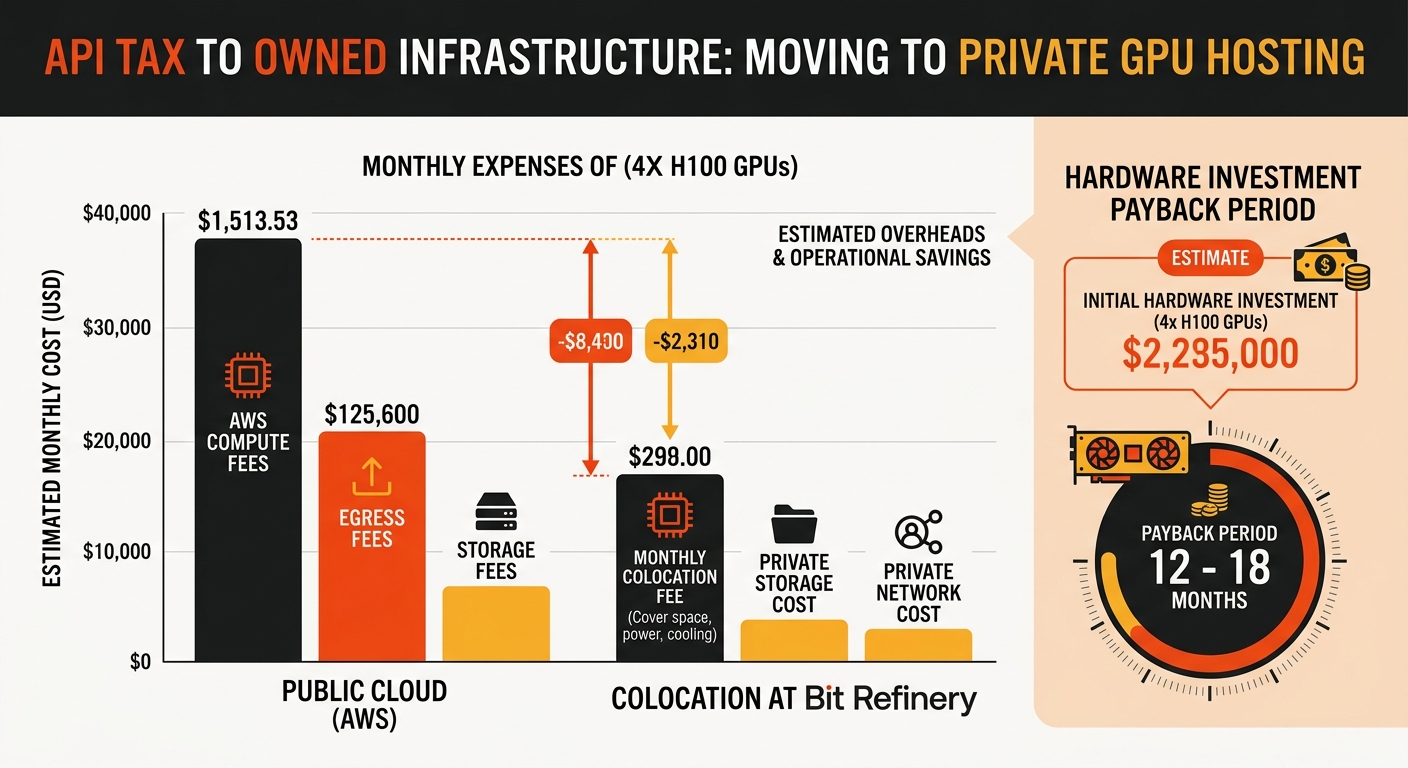
Let's put some numbers to this. A team running 4x H100 GPUs on AWS at reserved pricing might be paying somewhere in the range of $40,000–$60,000 per month. That's before egress, before storage, before the other supporting infrastructure.
Colocating those same 4 GPUs at a facility like Bit Refinery's Denver data center starts at $600/month per GPU for colocation — so $2,400/month for the physical hosting. You own the hardware (which you'd have purchased outright, typically $25,000–$35,000 per H100), and you're not paying per-hour rates ever again. Egress is included. Bandwidth is included.
Even accounting for the capital cost of the hardware, most teams see full payback within 6–12 months compared to equivalent cloud GPU spend. After that, you're running at a fraction of the cost.
What to Think About Before You Make the Move
This isn't the right move for every team. A few honest considerations:
Your workload needs to be predictable enough. If you genuinely don't know whether you'll need 2 GPUs or 20 next month, dedicated hardware is harder to justify. But if you're past the experimentation phase and running real production workloads, you probably have more predictability than you think.
You need someone to manage the infrastructure. Bare metal is powerful but it's not self-managing. You either need internal ops capacity or a managed service that handles monitoring, maintenance, and incident response. This is where a lot of DIY bare-metal experiments fall apart — the hardware is cheap, the management isn't.
Hardware ages. GPU generations move fast. An H100 you buy today will be two generations behind in three years. That's a real consideration for teams doing cutting-edge research. For production inference workloads, it matters a lot less.
The Trend Is Real
We're seeing this shift accelerate across the industry. Not just at big enterprises — mid-size AI teams, ML platforms at growth-stage startups, internal AI tooling teams at non-tech companies. The pattern is consistent: you hit a certain scale of GPU utilization, the cloud bill becomes the loudest thing in the room, and someone finally does the math.
The infrastructure for private GPU hosting has gotten genuinely good. Modern colocation facilities offer the same reliability guarantees as hyperscale cloud (99.99% uptime is standard), with enterprise networking, remote management tools, and support that doesn't involve a ticket queue.
The API tax is optional. More teams are figuring that out.
Bit Refinery offers BYOGPU colocation starting at $600/month per GPU at our Denver and Seattle data centers, with full SSH, IPMI, and VPN access within 48 hours. We also offer bare-metal GPU servers and managed ClickHouse/Trino deployments for teams building serious data infrastructure. Get in touch if you want to talk through what the move would look like for your workload.