
For the past couple years, running AI workloads has been almost suspiciously cheap. Cloud providers were practically giving away GPU time. API costs kept dropping. It felt like the party would never end.
It's ending.
Kevin Simback of startup incubator Delphi Labs put a name to what we've all been living through: the era of "subsidized intelligence." Investors were essentially writing blank checks so companies like OpenAI and Anthropic could offer AI on the cheap — hook the customers first, figure out profitability later. Classic Silicon Valley playbook. And it worked. Brilliantly.
But now both OpenAI and Anthropic are eyeing public markets. When you're trying to attract main street investors, "we lose money on every API call" stops being a growth story and starts being a liability. The pressure to actually make money is real, and it's coming fast.
So what happens to your AI infrastructure budget when the subsidies dry up?
The Variable Cost Trap
Here's the thing about building on cloud GPU infrastructure — it feels cheap until it doesn't. You start with a few spot instances, maybe some on-demand H100 time, and the bill is manageable. Then your model gets more complex, your inference volume grows, your team starts running more experiments, and suddenly you're staring at a cloud bill that's doubled in three months with no real ceiling in sight.
Cloud providers love this model. Every GPU hour is a revenue opportunity. Every token processed is a billing event. And when the underlying economics shift — when NVIDIA raises prices, when demand spikes, when the subsidies from VC money stop flowing through to you as artificially low prices — you absorb that cost. You have no choice. You're on their infrastructure, playing by their rules.
AWS, Azure, and GCP have been competing hard on GPU pricing because they're all chasing the same AI gold rush. But that competitive pressure has limits. When the major AI labs need to start showing margins, the whole ecosystem reprices upward. It's not a question of if, it's when.
What Fixed-Cost GPU Hosting Actually Means
At Bit Refinery, we do something pretty different. You ship us your GPU hardware — NVIDIA H100s, A100s, RTX 4090s, whatever you're running — and we rack it, cable it, configure it, and hand you full SSH, IPMI, and VPN access within 48 hours. From that point on, your monthly cost is fixed. $600 per GPU per month, full stop.
No per-hour billing. No egress fees eating into your budget every time you move training data around. No surprise charges when you run a long experiment over the weekend. You know exactly what you're paying, every single month.
That predictability isn't just a nice-to-have — it's genuinely strategic right now. If you own the hardware and we host it, you've essentially decoupled your infrastructure costs from whatever repricing happens in the broader AI market. The subsidized intelligence era ending doesn't affect you the same way it affects the team that's 100% on cloud GPUs.
The Numbers Are Hard to Argue With
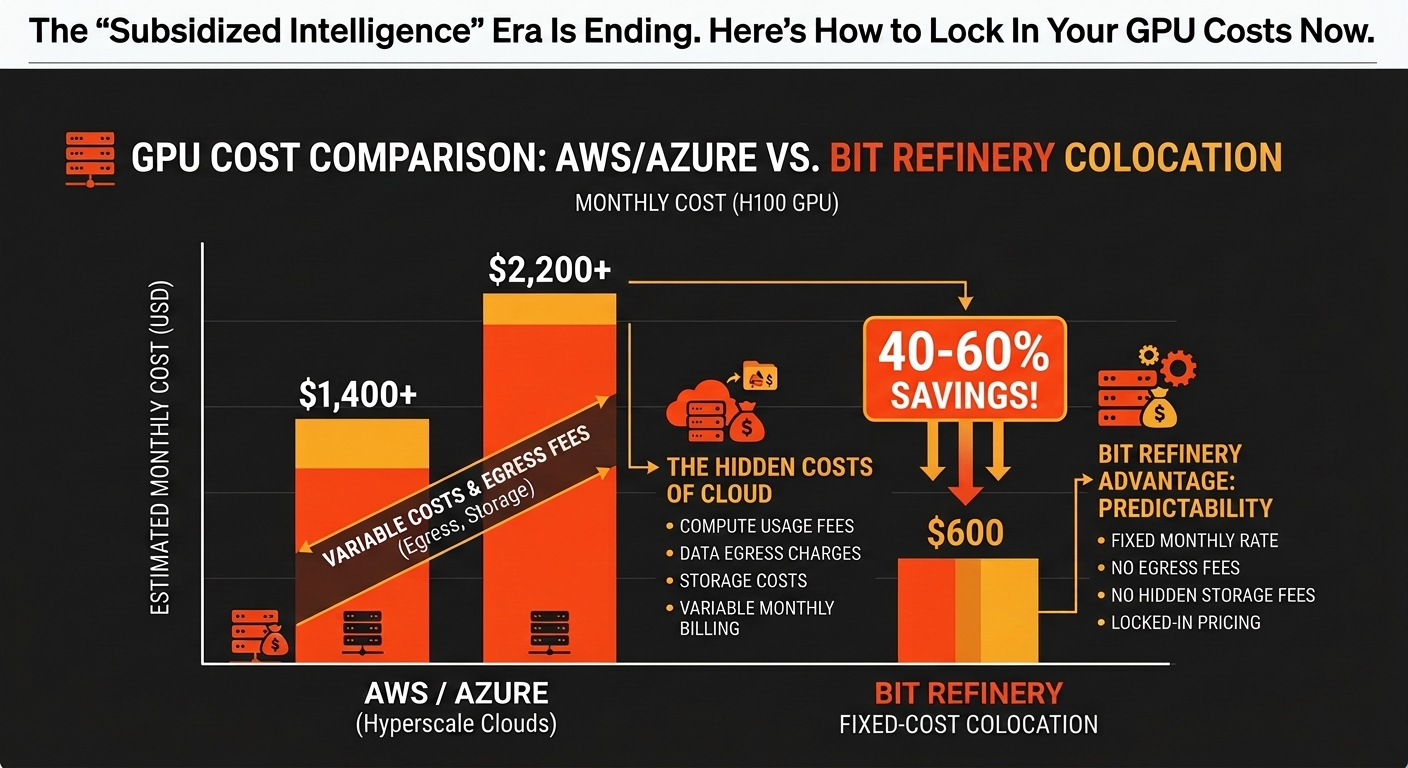
Let's be concrete. Running comparable GPU capacity on AWS or Azure — we're talking H100s with the storage and networking to actually do serious work — you're often looking at $2 to $3 per GPU hour on demand, more if you need reserved capacity with flexibility. An H100 running 24/7 for a month is roughly 720 hours. Do that math and you're at $1,400 to $2,200 per GPU per month, just for the compute. Add egress, add storage, add the other cloud services that quietly attach themselves to your workload, and the real number climbs fast.
Our BYOGPU colocation starts at $600 per GPU per month. That's 40 to 60 percent savings compared to cloud GPU rentals, and that estimate was made before the repricing pressure we're about to see hits the market.
The hardware cost of buying your own H100 is real — we're not pretending it isn't. But if you're running sustained AI workloads and you're planning to be doing this for more than a year, the math on ownership plus colocation versus perpetual cloud rental gets pretty compelling pretty quickly.
"Own the Base, Rent the Spike"
This is actually our core philosophy at Bit Refinery and it maps perfectly onto how serious AI teams should be thinking about infrastructure. Own your baseline capacity — the training runs, the inference serving, the experimentation that happens every single day. Put that on hardware you control, hosted at fixed cost.
Then when you genuinely need to burst — a massive one-time training job, a product launch that spikes inference demand — rent cloud capacity for that specific window. You're not locked into cloud. You're just not paying cloud prices for workloads that don't need to be there.
It's the same logic that data centers have applied to compute for decades. The AI era doesn't change the fundamental economics, it just makes the stakes higher.
Denver Infrastructure, Free Google Cloud Interconnect
One more thing worth mentioning for teams doing hybrid work — our Denver data center includes a free Google Cloud Interconnect. That means your bare metal GPUs can talk to GCP services like Vertex AI, BigQuery, or Cloud Storage at sub-millisecond latency with no egress fees on the Bit Refinery side and dramatically reduced fees on the GCP side.
For a lot of AI workflows, that's genuinely useful. Train on your own hardware, serve or fine-tune through managed cloud services, move data back and forth without getting killed on transfer costs. AWS Direct Connect runs $1,500 to $2,250 a month. Azure ExpressRoute is even worse. Ours is included.
The Time to Act Is Before the Repricing Happens
Here's the honest take: if you're running serious AI workloads today and you're entirely dependent on cloud GPU pricing staying where it is, you're exposed. The subsidized intelligence era gave everyone a window to build without worrying too much about infrastructure economics. That window is closing.
Locking in fixed-cost GPU hosting now — before OpenAI's IPO road show, before Anthropic needs to show margins, before the whole ecosystem reprices — is one of the more straightforward risk mitigation moves available to engineering and infrastructure teams right now.
If you want to talk through what that looks like for your specific workloads, reach out to us. We're happy to run the numbers with you.