
If you've ever sat in a budget review meeting and had to explain why your IBM Planning Analytics cloud bill jumped 40% quarter-over-quarter — without any meaningful change in usage — you already know the problem we're talking about.
Cloud-hosted TM1 environments have a way of starting out reasonable and quietly becoming one of those line items that finance teams circle in red every quarter. And honestly, it's not a mystery why. IBM Planning Analytics is a memory-hungry, compute-intensive beast. It needs fast storage, lots of RAM, and consistent CPU availability. Public cloud infrastructure can technically provide all of that — but you'll pay for every gigabyte of memory, every I/O spike, and definitely every gigabyte of data you try to move out.
What's Actually Driving Your Cloud TM1 Costs
Let's be specific. A properly sized Planning Analytics environment for a mid-to-large enterprise typically needs:
- 512 GB to 3 TB of RAM — TM1 loads cubes entirely into memory, so this isn't optional
- Fast NVMe storage for transaction logs, feeders, and TurboIntegrator processes
- Consistent, low-latency CPU for consolidation runs and what-if modeling
- High-bandwidth connectivity to your data sources, ERP systems, and end users
On AWS, an r6i.metal instance with 1 TB of RAM runs around $6,000–$7,000/month before you add storage, networking, or any managed services. Push that to 3 TB and you're looking at well over $15,000/month — just for compute. Then add egress. If your Planning Analytics environment is pulling data from on-prem ERP systems, pushing reports to finance teams across regions, or syncing with data warehouses, those transfer costs stack up fast. AWS charges $0.09/GB out. That sounds small until you're moving terabytes every month.
And we haven't even touched IBM licensing yet, which is its own conversation.
The Case for Bare Metal
Here's the thing about TM1: it was designed for dedicated hardware. The whole architecture assumes it owns the memory it's allocated. Virtualization overhead, noisy neighbors, and shared CPU resources all create unpredictable performance — exactly the kind of thing you don't want during a month-end close when your CFO is waiting on consolidations to finish.
Dedicated bare metal eliminates that entirely. You get the full machine. No hypervisor tax, no shared resource contention, no surprises.
At Bit Refinery, our Platinum tier — 80 cores, 3 TB DDR4/DDR5 RAM, 150 TB of RAID6 NVMe SSD — runs $4,000/month. Flat. With $0 egress fees and unlimited bandwidth included. That's a machine that can comfortably run a serious enterprise Planning Analytics environment with room to spare, at less than a third of what you'd spend on comparable AWS infrastructure.
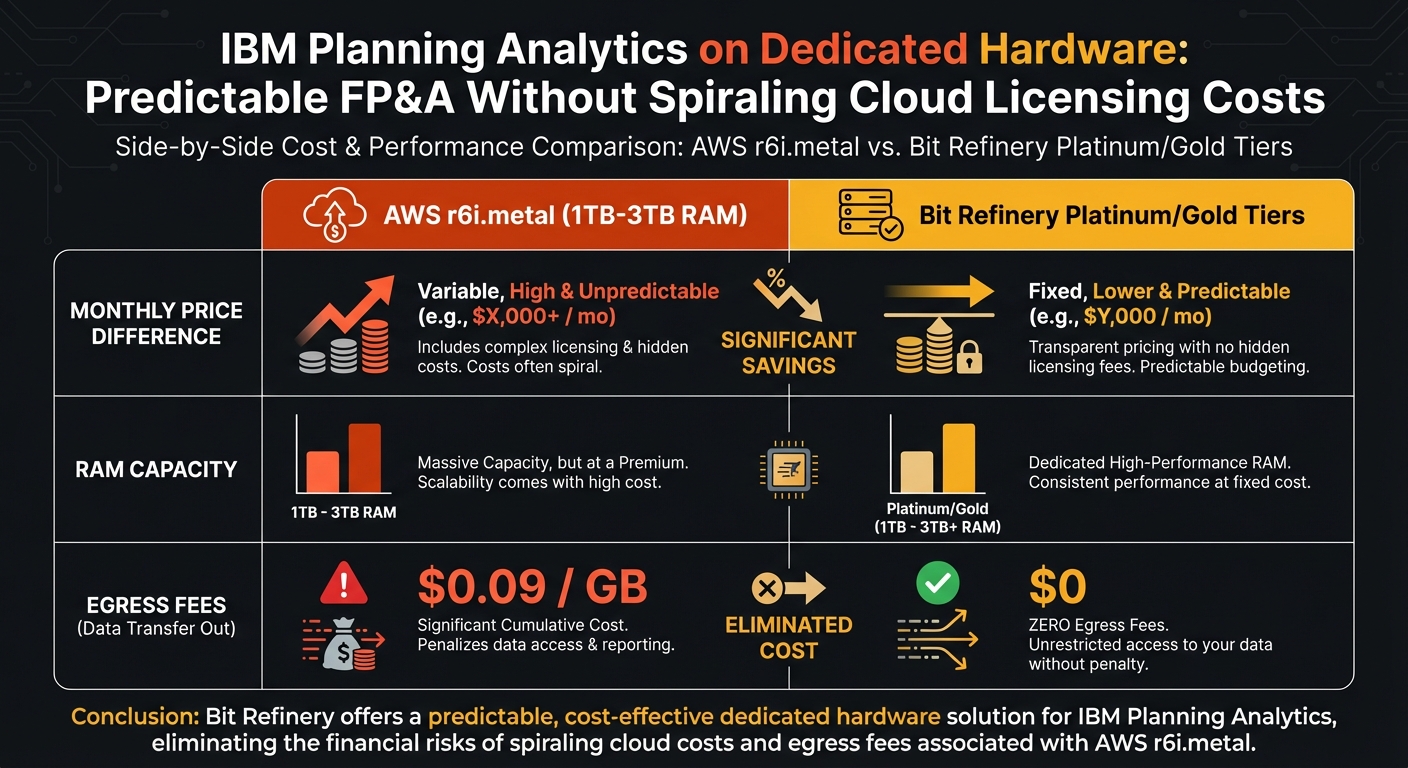
The Gold tier (80 cores, 1 TB RAM, 44 TB SSD) at $2,800/month covers a lot of mid-market TM1 deployments without breaking a sweat.
But What About the Managed Services Part?
This is where a lot of teams hesitate. Moving off cloud means giving up the managed convenience — or so the thinking goes. You don't have to.
We partner with Data41 to deliver fully managed IBM Planning Analytics services on our bare metal infrastructure. That means:
- Environment architecture and setup — proper cube design, dimension hierarchies, and server configuration from people who actually know TM1
- SSO integration — connecting your Planning Analytics environment to your existing identity provider so you're not managing a separate auth system
- TurboIntegrator tuning — TI processes that run in minutes instead of hours, because someone who knows what they're doing actually looked at them
- 24/7 monitoring with SLA-backed response times — not a generic NOC reading from a runbook, but engineers who understand what a Planning Analytics environment is supposed to look like
- Budgeting, forecasting, consolidation, and scenario modeling support — the actual FP&A use cases, not just keeping the lights on
So you get dedicated hardware performance and managed operations. That combination is genuinely hard to find.
Real-World Scenarios Where This Matters
Month-end close performance. When your consolidation runs are competing with other tenants on shared cloud infrastructure, you get variable performance at exactly the wrong time. On dedicated hardware, your close runs the same way every time.
Large model sizes. Some enterprise TM1 deployments have cubes that need 500+ GB of RAM just to load. On cloud, you're paying premium rates for memory-optimized instances. On our Platinum tier, that's a fraction of the available RAM — plenty of headroom for growth.
Data integration pipelines. Most Planning Analytics environments pull from ERP, GL systems, HR platforms, and data warehouses. Moving that data around on cloud racks up egress costs constantly. On bare metal with $0 egress, you run your integrations as often as you need to without watching a meter.
Multi-entity or multi-currency consolidations. These are compute-heavy operations. Dedicated CPU without virtualization overhead means faster consolidations, period.
The Predictability Argument
I want to spend a minute on this because it's underrated. Finance teams hate unpredictable infrastructure costs. It's a little ironic — you're running an FP&A platform on infrastructure that makes FP&A harder because the costs themselves are hard to plan.
With bare metal, your infrastructure line item is fixed. $2,800/month or $4,000/month, every month, regardless of how many TI processes you run, how much data you pull, or how many users are hammering the system during budget season. That predictability has real organizational value beyond just the dollar amount.
Is It Right for You?
Not every Planning Analytics deployment needs this. If you've got a small model, a handful of users, and minimal data movement, cloud might be perfectly fine. But if you're running a serious enterprise FP&A environment — multiple entities, large cube sizes, heavy data integration, demanding consolidation schedules — dedicated bare metal is worth a hard look.
The math usually works out pretty clearly once you add up what you're actually spending on cloud compute, storage, egress, and whatever managed services you're paying for on top.
Want to talk through your specific environment? Reach out to us — we're happy to work through the numbers with you and figure out whether dedicated hardware makes sense for your Planning Analytics deployment.