Moonshot AI shipped Kimi K3 last week: 2.8 trillion parameters, a million-token context window, native vision, and benchmark scores that sit right on top of the frontier American models. It's the largest open-weight model anyone has released. The weights are scheduled to land publicly on July 27.
Within days, White House OSTP director Michael Kratsios accused Moonshot of running a "sophisticated internal platform to conduct large scale distillation against U.S. models" — naming Anthropic's Fable specifically — and of training on Nvidia GB300 systems that aren't supposed to ship to China. Treasury Secretary Scott Bessent followed with a warning that "sanctions and Entity List designations will be on the table." With the administration reportedly weighing curbs on foreign open-weight models, 179 American companies organized as the Little Tech Association — Y Combinator and Proton among them — wrote in asking it not to, calling a ban "a tax on intelligence."
That's the news cycle. Here's the part that matters if you actually build things: none of this argument is about whether the model is good. It's about who gets to hold the weights. And that's an infrastructure question, not a policy question.
What Kimi K3 actually is
Strip out the geopolitics and the technical picture is genuinely interesting:
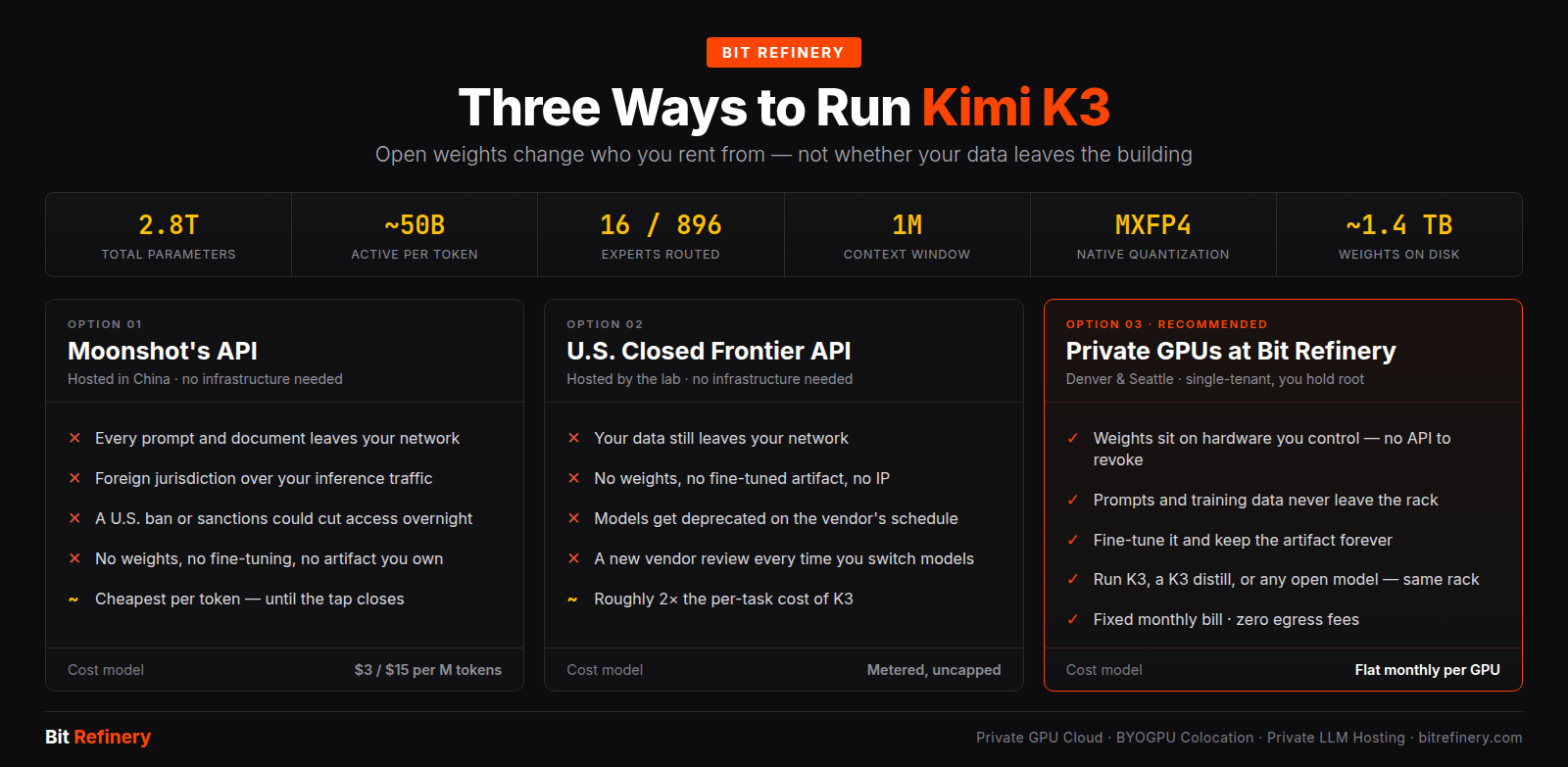
- 2.8 trillion total parameters, but it's a sparse mixture-of-experts model — only 16 of 896 experts fire per token, so you're paying roughly 50 billion parameters' worth of compute per forward pass. Frontier-scale knowledge, mid-size inference cost.
- 1 million token context built on Moonshot's Kimi Delta Attention, a hybrid linear attention scheme, plus "Attention Residuals" as a drop-in replacement for standard residual connections.
- Native visual understanding — images and video go in as direct input, not through a bolted-on adapter.
- MXFP4 weights with MXFP8 activations, trained that way rather than quantized afterward. That's quantization-aware training, and it's why the checkpoint lands around 1.4 TB on disk instead of 5.6 TB in FP16.
- On Moonshot's own API it prices at $3 / $15 per million tokens in and out — roughly half the per-task cost of the American models it trades benchmark wins with.
The MXFP4 detail is the one worth circling. Four-bit weights with per-block scaling are natively supported by Nvidia Blackwell and AMD MI400 silicon. Moonshot didn't just release a big model — they released one designed from the start to be run by someone other than themselves.
Why Washington is nervous
The charge is distillation: that Moonshot built internal tooling to farm outputs from American frontier models at industrial scale, rotating access methods to stay ahead of detection, and trained K3 on the results. It isn't a new charge. Anthropic went public roughly six months ago accusing Moonshot, DeepSeek, and MiniMax of exactly this, and put numbers on it — more than 16 million interactions with Claude across some 24,000 fake accounts.
Researchers are skeptical of the strongest version of the K3 claim, mostly on timeline grounds. Fable only went public on July 1; K3 landed about two weeks later. "I don't think you get a model this strong and this quickly on the heels of Fable doing strictly distillation," Braden Hancock of the Laude Institute told TechCrunch. Nathan Lambert at the Allen Institute made a related point: distillation buys you less and less as the gap closes, particularly once training leans on reinforcement learning. Moonshot hasn't answered questions about its methodology, and the White House hasn't said how it determined K3 came from Fable.
We don't have a horse in that race and we won't pretend to adjudicate it. But it's worth being precise about who is arguing for what, because the industry is not lined up the way the headlines suggest.
Accusing a competitor of distillation and asking Washington to ban open weights are two different moves. Anthropic has made the first, loudly and on the record. The push for actual import restrictions is coming from elsewhere — voices like Dean Ball, a former White House AI adviser now at OpenAI, plus the administration's own internal deliberations. Meanwhile some of the largest American AI companies are on the other side of it: Nvidia, Microsoft, and Meta have all warned publicly against premature restrictions on open-weight models. This is not open-source scrappies versus closed-lab incumbents. It's messier than that.
The uncomfortable question underneath is one plenty of people in the industry ask quietly: the frontier labs spent years arguing that training on the entire public internet — including, in one case, seven million books from pirate sites, a suit settled for $1.5 billion — was fair use. Learning from someone else's outputs is either a thing you're allowed to do or it isn't. Reasonable people land in different places, and wherever that line settles will shape what American companies are allowed to build on.
You don't have to resolve any of it to see the practical consequence. If open weights get restricted, the cost of intelligence for American companies goes up and stays up. Every U.S. startup that bootstrapped a product by forking an open-weight model and continuing training on its own hardware loses that on-ramp. Everyone else keeps it.
The part everyone's missing
Here's what strikes us, watching this from inside a data center rather than from a policy desk.
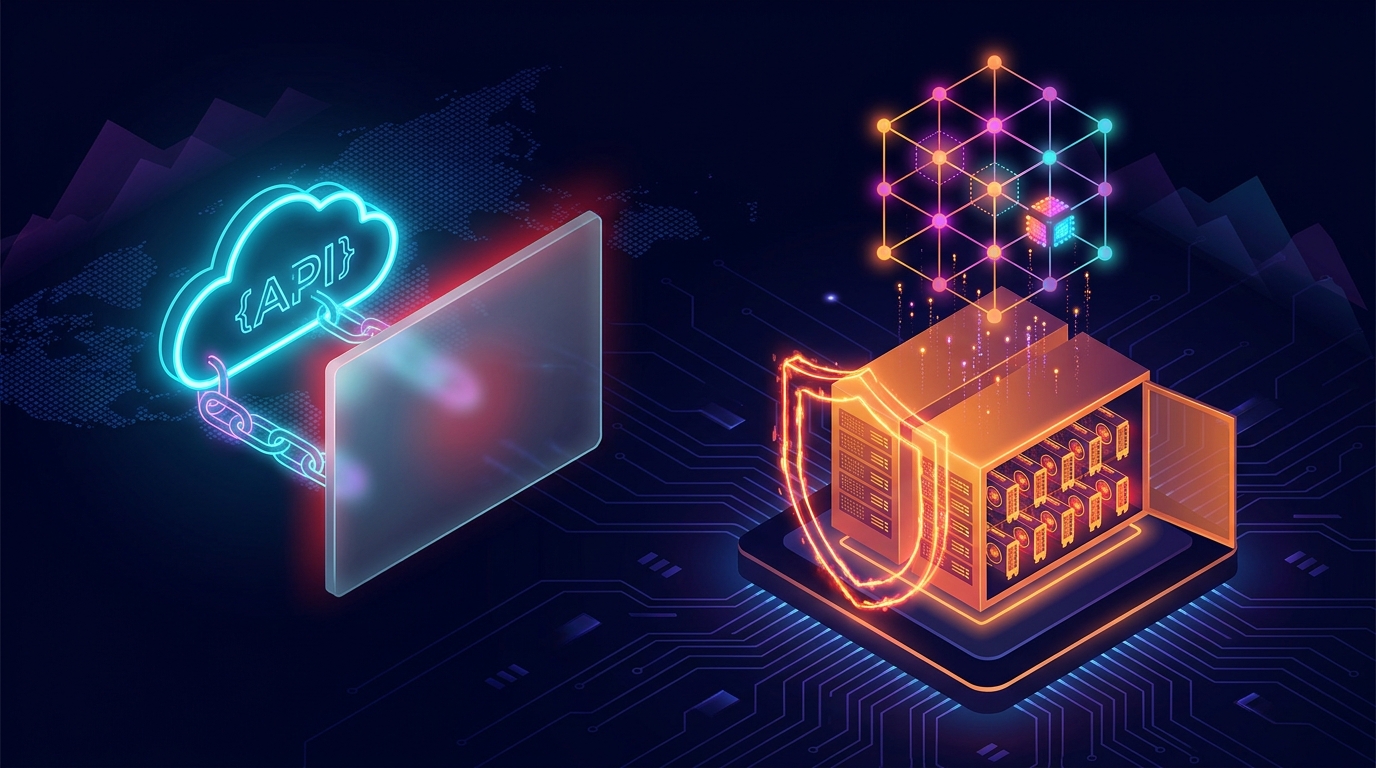
Every option in this debate that involves an API — Moonshot's, OpenAI's, Anthropic's — has the same failure mode. Your data leaves your building, and somebody else decides whether the endpoint answers tomorrow. A sanctions regime can turn off a Chinese API. A vendor deprecation notice can turn off an American one. In both cases the thing you built your workflow on stops existing and you had no vote.
Open weights are the only option that breaks that pattern — but only if you actually hold them. Calling a hosted K3 endpoint through some intermediary gets you the pricing and none of the durability. The model is open; your access to it isn't.
A model checkpoint sitting on NVMe in a rack you have root on doesn't get deprecated. It doesn't get sanctioned. It doesn't change its refusal behavior in a Tuesday update. That's not an ideological position — it's just what owning the artifact means.
What it actually takes to run K3
We'll be straight with you, because a lot of vendors won't be: full Kimi K3 is not a one-box deployment. Nobody's single H100, H200, or B200 holds it.
At MXFP4 you're looking at roughly 1.4 TB of weights before you've allocated a single byte of KV cache. Practical guidance circulating ahead of the weight release points at something like an 8-node cluster of 8×80 GB GPUs — around 5 TB of aggregate VRAM — to serve it comfortably with the full context window. Denser cards change the math: eight H200s at 141 GB each gets you 1.1 TB in a single node, which is enough for the weights with real headroom, and Blackwell parts handle MXFP4 natively rather than emulating it.
Serving it will want vLLM, SGLang, or TensorRT-LLM with MoE-aware scheduling — 896 experts is well past what stock routing implementations were tuned for, and Moonshot has said its Kimi Delta Attention support for vLLM arrives alongside the weights. Expect the first two weeks after July 27 to be rough. They always are.
None of that is a reason not to do it. It's a reason to have someone who racks GPUs for a living do the racking.
You probably don't need all 2.8 trillion parameters
This is the honest consultative part, and it's the same thing we tell customers who show up asking for eight H100s because a blog post said so.
Most production workloads are not frontier-intelligence problems. They're domain problems. Document extraction, code review, ticket triage, structured summarization, internal Q&A over a knowledge base — a well-chosen 7B–32B open model, fine-tuned on your data, beats a giant general model on your specific task while costing a fraction of the compute. We've laid that math out before, and K3 doesn't change it.
What K3 does change is the ceiling. When you need frontier reasoning on a hard subset of your workload, there's now an open-weight option for it, and the distills that follow a release like this — smaller models trained on the big one's outputs — usually show up within weeks and land in the sweet spot most teams actually want.
The sane architecture is the one we've been recommending all along: own the base, route the spike. Run the model that handles 90% of your volume on hardware you control at a fixed monthly cost. Keep a path to something bigger for the cases that need it. What you don't do is pay metered frontier pricing on every ticket-classification call for the rest of your life.
How Bit Refinery partners with you on this
We're a Colorado data center company that racks GPUs and runs them for other people. Concretely, there are four ways this works:
Private GPU Cloud — dedicated NVIDIA GPU pods with NVLink between cards, root access, and single-tenant isolation. RTX 6000 Ada 48 GB and RTX PRO 5000 Blackwell 48 GB are our off-the-shelf defaults, one to seven cards per pod. Flat monthly billing, no egress fees, and your data is never used to train anything. This is where most teams start: pick an open model, put it on vLLM, point your app at it.
Custom multi-node builds — H100, H200, L40S, and A100 pods on request. If you genuinely need full K3 at 1M context, this is the conversation. Tell us the workload and the concurrency target and we'll spec the aggregate VRAM, the interconnect, and the storage to hold a 1.4 TB checkpoint, then quote you the fastest path to a working cluster.
BYOGPU — you already bought the cards, or you're going to. We colocate and operate them: power, cooling, networking, remote hands, monitoring. Starts at $600/month per GPU. For teams with capital budget and a multi-year horizon, this is the cheapest per-token compute available anywhere, by a wide margin.
Private LLM Hosting — the managed version. You tell us which models, how many users, and what compliance regime you're under; we handle deployment, the inference engine, quantization, and optimization. Qwen, Llama, Mistral, Gemma, DeepSeek distills, or your own fine-tuned weights in GGUF, GPTQ, AWQ, or SafeTensors.
All of it runs out of Denver-metro and Seattle facilities. If you want to see what that actually looks like before you talk to anyone, we built a walkthrough of the GPU floor — through the doors, down the cold aisle, into an open rack.
The compliance angle nobody wants to think about yet
If you're in healthcare, financial services, defense, or anything with a procurement office, this whole episode should be setting off alarms for a reason that has nothing to do with model quality.
Ask yourself what happens if your legal team gets asked, six months from now, to certify where your inference traffic goes. If the answer involves an API endpoint in a jurisdiction that just got named in a Treasury sanctions threat, that's a problem. If the answer involves a U.S. vendor's API, it's a better problem — but it's still a data-leaves-the-building problem, and it's still a new vendor review every time you switch models.
If the answer is "a single-tenant rack in Denver that we hold root on," the review is short.
That's the argument for private GPU infrastructure that survives whichever way the policy fight goes. A ban on Chinese open weights doesn't help you if your data is already flowing to a hosted API. Owning your compute is the only position that's correct under every outcome.
What we'd do this week
- Download the weights when they drop on July 27. Whatever the policy environment turns into, a checkpoint on your own storage is not retroactively revocable. Storage is cheap; optionality isn't.
- Inventory what you're actually spending on metered inference, broken out by workload. Most teams find that 80–90% of their token spend is on tasks a fine-tuned mid-size model handles fine.
- Move that 80% onto hardware you control. Fixed monthly cost, no egress, no deprecation risk, no vendor review.
- Keep a path to frontier scale for the workloads that genuinely need it — whether that's full K3 on a custom cluster or a metered API you use deliberately rather than by default.
The Kimi K3 fight is going to run for months, and we have no idea how it lands. What we do know is that the companies who come out of it in good shape are the ones who spent this quarter making sure their AI stack doesn't depend on anybody's permission.
Bit Refinery runs private GPU cloud, BYOGPU colocation, and managed private LLM hosting out of Tier III data centers in Denver and Seattle. If you're sizing hardware for an open-weight deployment — K3 or anything else — get in touch and we'll spec it with you.