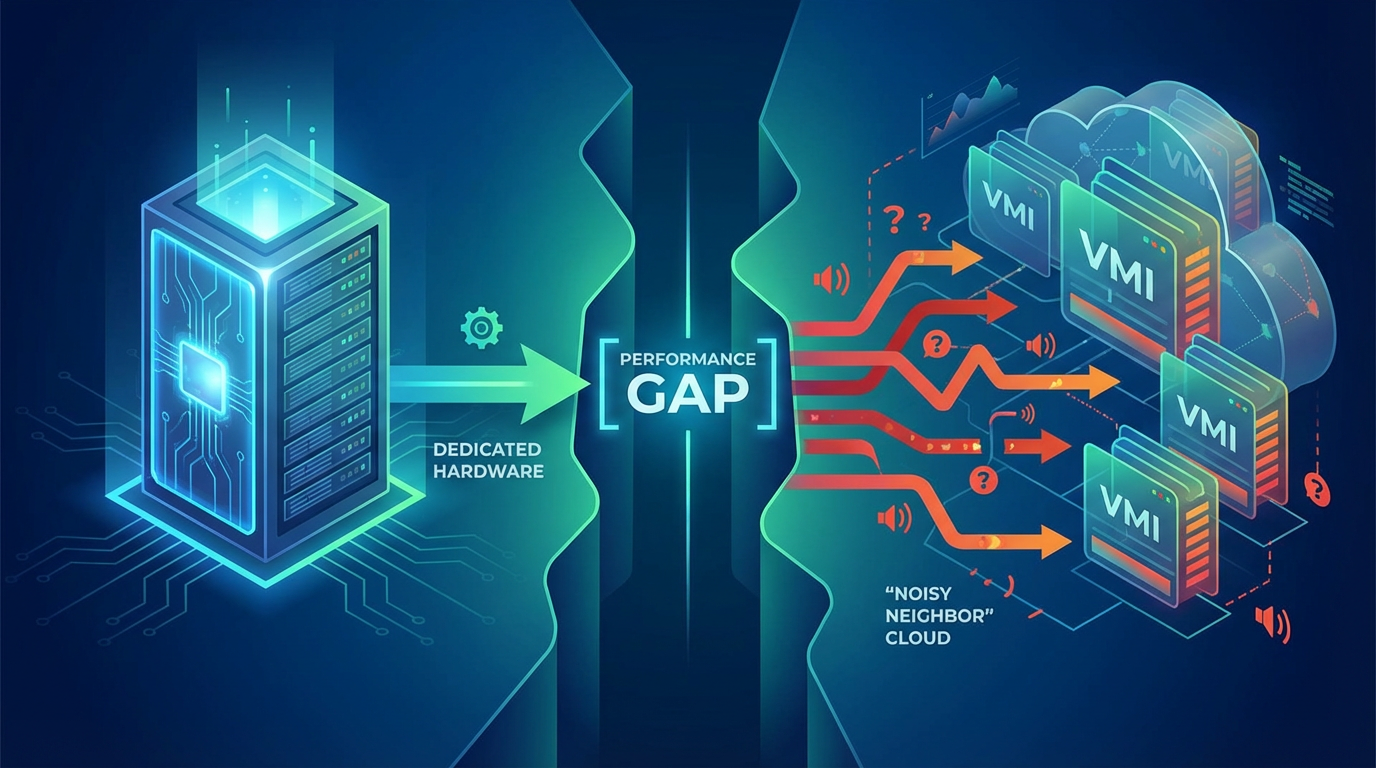
In the world of cloud computing, the term "elasticity" is often used as a catch-all for efficiency. For many DevOps and data engineers, however, the reality of hyperscale cloud environments (AWS, Azure, GCP) involves a frustrating phenomenon known as the "noisy neighbor."
When you rent a virtual machine (VM) from a public cloud provider, you aren't just renting a slice of a server; you are entering into a multi-tenant agreement where your application's performance is inextricably linked to the behavior of other workloads on the same physical host.
At Bit Refinery, we advocate for a "Own the Base, Rent the Spike" philosophy. To understand why, we need to look at the technical architecture of virtualization and why dedicated bare metal is the only way to achieve true performance predictability.
The Mechanics of the Noisy Neighbor
In a standard virtualized environment, a hypervisor manages the distribution of physical resources (CPU, RAM, I/O) among multiple virtual machines. While modern hypervisors are incredibly sophisticated, they are still fundamentally based on the concept of oversubscription.
Cloud providers often over-provision their physical hardware, betting on the fact that not every tenant will hit 100% CPU or disk utilization simultaneously. When a neighboring tenant on your physical host suddenly spikes in activity—perhaps running a massive batch job or a heavy database migration—the hypervisor must context-switch rapidly to accommodate them.
This leads to several performance degradations:
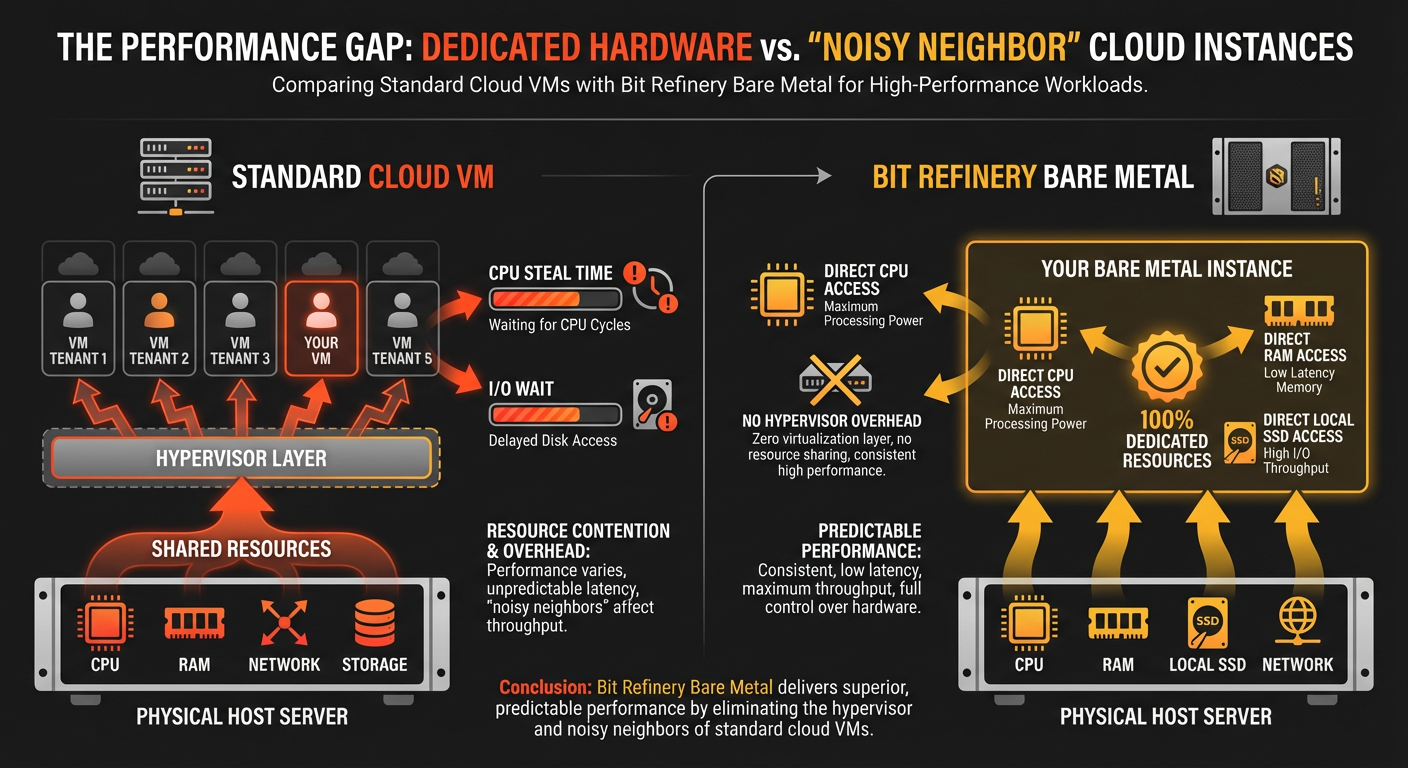
- Steal Time (st): Your CPU cycles are literally "stolen" by the hypervisor to serve another VM. If you run
topon a Linux instance and see a high%stvalue, your application is waiting on the hypervisor. - I/O Wait (wa): Disk and network throughput are often the first resources to saturate. Even with "provisioned IOPS," shared storage backends can suffer from latency spikes during peak usage hours.
- L3 Cache Contention: While RAM is usually isolated, the L3 cache on the processor is often shared. High-memory-bandwidth neighbors can flush your data out of the cache, leading to increased memory latency.
The Bare Metal Advantage: Raw Performance
Bare metal hosting removes the hypervisor layer entirely. When you deploy on a Bit Refinery Gold or Platinum tier server, the Intel Xeon or AMD EPYC processor is 100% dedicated to your kernel. There is no "Steal Time" because there is no one else to steal from.
CPU Determinism
For workloads like ClickHouse or Trino, which rely on massive parallelization and vectorized query execution, CPU determinism is critical. In a bare metal environment, every clock cycle is yours. This results in query response times that are not only faster but have significantly lower variance (jitter).
Storage Throughput without the "Cloud Tax"
Public clouds often throttle disk performance based on instance size or additional monthly fees. On a Bit Refinery Platinum server, you have direct access to up to 150 TB of RAID6 SSD storage. You aren't communicating with a remote block storage device over a congested internal network; you are talking to local disks at the speed of the PCIe bus.
Cost Efficiency: A Comparative Look
Beyond performance, the "noisy neighbor" model carries a hidden financial cost. To compensate for unpredictable performance, engineers often "over-size" their cloud instances—paying for a 64-core machine to ensure they get the performance of a 32-core machine during peak times.
Let's look at the math:
- AWS Scenario: An
r6i.metalinstance with roughly 40 TB of storage and heavy data transfer can easily exceed $26,000/month when you factor in egress fees (typically $0.05–$0.09/GB). - Bit Refinery Gold: A dedicated server with 80 cores, 1 TB RAM, and 44 TB of SSD storage costs $2,800/month.
Because Bit Refinery offers $0 egress fees and unlimited 1 Gbps bandwidth, the price you see is the price you pay. You no longer have to pay a premium just to escape your neighbors.
When to Stay in the Public Cloud vs. Moving to Bare Metal
We don't suggest that bare metal is the solution for every workload. The public cloud is excellent for:
- Short-lived dev/test environments.
- Highly bursty workloads that only run for a few hours a week.
- Global edge distribution of static content.
However, for your baseline production workloads—your primary ClickHouse clusters, your IBM Planning Analytics (TM1) instances, or your AI/ML training datasets—bare metal is the superior choice. This is the "Own the Base" part of our philosophy. By moving your predictable, heavy-duty workloads to dedicated hardware, you gain performance stability and massive cost savings, while still maintaining the ability to "Rent the Spike" in the public cloud for overflow.
Modern Virtualization: The VergeOS Middle Ground
If you still require the flexibility of virtual machines but want to avoid the pitfalls of hyperscale multi-tenancy, Bit Refinery offers VergeOS. Unlike traditional virtualization, VergeOS is an ultraconverged platform that integrates compute, storage, and networking into a single efficient kernel.
We offer Dedicated Virtual Servers, where we provide a single-tenant VergeOS environment on dedicated bare metal. This gives you the management ease of a VM (snapshots, easy migrations, SDN) with the hardware isolation of bare metal. No neighbors, no noise.
Conclusion
The "Performance Gap" is real, and for data-intensive organizations, it manifests as inconsistent user experiences and inflated cloud bills. By choosing dedicated hardware, you eliminate the variables that cause performance jitter.
If you're tired of seeing high CPU steal times and unpredictable I/O, it's time to look at the underlying hardware. At Bit Refinery, we provide the raw power of Dell PowerEdge servers combined with the transparency of fixed monthly pricing.
Ready to see what your stack can do without the noise? Contact us for a custom hardware quote or a consultation on migrating your ClickHouse or Trino workloads to bare metal.