
There's a conversation happening in a lot of compliance and engineering meetings right now, and it goes something like this: "We want to run this model on our patient data" or "we need to fine-tune on our trading history" — and then someone in legal asks the obvious question. Where does that data actually go?
For teams in healthcare, finance, government, and anywhere else that handles sensitive data, that question isn't rhetorical. It has real regulatory teeth. HIPAA, SOC 2, FedRAMP, GDPR, FINRA — the list of frameworks that care deeply about data residency and access controls keeps growing. And the default answer most cloud GPU providers give you ("don't worry, it's encrypted") is increasingly not going to cut it, which is why your data doesn't belong in someone else's API when dealing with strict compliance mandates.
The Problem with Shared GPU Clouds
Public cloud GPU instances are genuinely impressive. NVIDIA H100s on demand, pay-per-hour, no hardware procurement headaches. For a lot of workloads, that's totally fine.
But when you're training on PHI, running inference over financial records, or processing anything that touches government data, "shared infrastructure" starts to look a lot less appealing. The core issue isn't that AWS or Azure are bad actors — they're not. It's that the architecture itself creates ambiguity.
Who else is running on that physical node? What does the hypervisor boundary actually guarantee? When your data gets pulled into GPU memory for a training pass, what's the blast radius if something goes wrong at the hardware level? These aren't paranoid questions. They're the exact questions your auditors are going to ask.
And honestly, even setting compliance aside for a second — a lot of teams just don't want their proprietary model weights and training data sitting on infrastructure they have zero visibility into. That's a legitimate engineering concern, not just a legal one.
What Data Sovereignty Actually Means for GPU Workloads
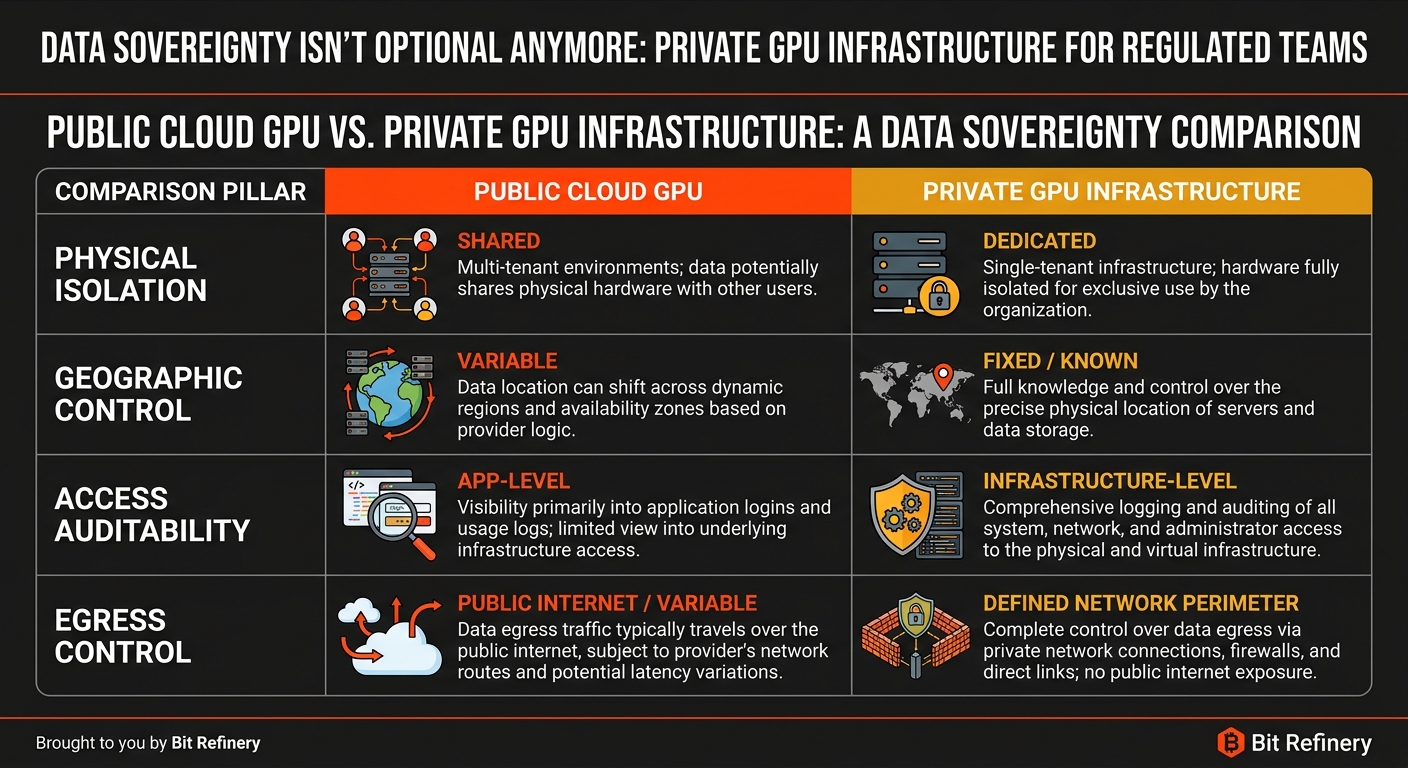
Data sovereignty is one of those terms that gets thrown around loosely. In practice, for GPU infrastructure, it means a few concrete things:
Physical isolation. Your workload runs on hardware that no other tenant can touch. Not a VM boundary, not a container — actual dedicated silicon.
Geographic control. You know exactly which data center your data is in, and that data center is in a jurisdiction that aligns with your compliance requirements.
Access auditability. You can produce logs showing who accessed what, when, and from where. Not just application-level logs — infrastructure-level ones.
Egress control. Your training data doesn't leave a defined network perimeter unless you explicitly allow it to.
Cloud GPU rentals check some of these boxes some of the time. Private GPU infrastructure checks all of them, all of the time. When evaluating providers, it is critical to understand what to actually look for in private AI infrastructure to ensure these standards are met.
The BYOGPU Approach
One model that's gaining traction — especially among teams that already own GPU hardware or are planning to buy — is colocation. You own the GPUs, someone else manages the data center infrastructure around them.
This is exactly what we do at Bit Refinery with our BYOGPU program. You ship your hardware — NVIDIA H100s, A100s, RTX 4090s, AMD MI300X, whatever you're running — and we rack it, cable it, configure the networking, and hand you SSH, IPMI, and VPN access within 48 hours. The hardware is yours. The data never touches anyone else's compute.
Starting at $600/month per GPU, it's a meaningful step down from cloud GPU rental rates, which can run $2–4/hour per H100 (that's $1,440–$2,880/month per card at continuous utilization, before egress). For teams running sustained training jobs, the real cost of cloud GPU rentals makes the economics get pretty stark pretty quickly.
But cost is almost secondary here. The real value for regulated teams is that you can walk into an audit and say, definitively, "our training data was processed on hardware we own, in a data center in Denver, Colorado, with no multi-tenant exposure." That's a very different conversation than explaining shared cloud tenancy to a HIPAA auditor.
Networking Matters Too
One thing that often gets overlooked in the GPU infrastructure conversation is data movement. Training pipelines don't just sit on a GPU — they pull data in from storage, push checkpoints out, talk to orchestration layers. Every one of those data flows is a potential compliance surface.
At our Denver facility, every server comes with a free Google Cloud Interconnect connection. Sub-millisecond latency, $0 egress from bare metal to GCP, and no port fees or cross-connect charges. If your inference serving runs on Vertex AI or your feature store lives in BigQuery, that's a private, auditable path between your GPU training environment and your cloud services — not traffic routing over the public internet.
For teams doing hybrid architectures (train on-prem, serve in cloud, or vice versa), this kind of dedicated connectivity isn't a nice-to-have. It's how you keep your data flows inside a defined compliance boundary.
The Compliance Posture Question
Here's something worth being direct about: a lot of teams are running AI workloads on public cloud GPU instances right now, and they haven't fully thought through what their compliance posture actually is. They've checked the "encryption at rest" box and moved on.
That's going to be fine until it isn't. Regulators are catching up to AI infrastructure faster than most people expected. The EU AI Act has data governance requirements baked in. HIPAA enforcement actions have started naming cloud configurations explicitly. And if you're in financial services, your next SOC 2 audit is going to have questions about AI workload data handling that weren't on the checklist two years ago.
Getting ahead of this isn't about being paranoid — it's just good engineering hygiene. As more teams are moving to private GPU hosting, they are finding that private infrastructure gives you a defensible answer to the "where does the data go" question. Shared cloud infrastructure gives you a complicated explanation that depends on which services you used, which region, and what the provider's current data processing addendum says.
A Practical Path Forward
If you're running AI workloads in a regulated environment and you haven't audited your GPU infrastructure's compliance posture, that's probably worth doing soon. The questions to ask are pretty simple:
- Can you produce an audit trail showing where training data was processed?
- Is your GPU infrastructure physically isolated from other tenants?
- Do you have contractual guarantees about data residency jurisdiction?
- Are your data flows between training infrastructure and storage/serving layers staying within a defined network perimeter?
If the answers are fuzzy, private GPU infrastructure — whether that's BYOGPU colocation or dedicated bare-metal GPU servers — is worth a serious look. Not because public cloud is inherently insecure, but because some compliance requirements genuinely need a cleaner architecture than shared tenancy can provide.
We work with teams across healthcare, finance, and government on exactly this kind of infrastructure setup. If you're trying to figure out what the right architecture looks like for your specific compliance requirements, we're happy to talk through it.