For many CTOs and DevOps engineers, Disaster Recovery (DR) is the technical equivalent of an insurance policy: you pay for it, hope you never use it, and often don't think about it until the bill is due or a crisis hits.
However, in an era of ransomware, regional cloud outages, and complex microservices, treating DR as a secondary 'bolt-on' is a recipe for catastrophic downtime. True business continuity isn't a backup script running on a cron job; it is a fundamental architectural strategy. At Bit Refinery, we believe the most resilient organizations are those that move away from reactive recovery toward proactive, infrastructure-level immutability.
The High Cost of the "Afterthought" Mentality
When DR is an afterthought, several critical gaps emerge:
- Recovery Time Objectives (RTO) are Theoretical: You think you can recover in 4 hours, but the last time you tested a full restore was eighteen months ago.
- Egress Fee Extortion: If your primary data is in a hyperscale cloud and your DR site is elsewhere, the cost of moving terabytes of data during a failover (or failback) can be financially ruinous.
- Configuration Drift: Your production environment has evolved, but your DR environment is still running the version of the stack from three deployments ago.
Shifting the Paradigm: Infrastructure-Level Resiliency
To move DR from a checkbox to a strategy, you need to look at the underlying layers of your stack. Here is how we approach building resilient environments for our clients.
1. Decouple Data from Compute with Bit Refinery S3 (MinIO)
Data is the hardest part of DR. Compute can be redeployed via Terraform in minutes, but data has gravity. By utilizing S3-compatible object storage powered by MinIO on bare metal, you gain several strategic advantages:
- Object Immutability: Protect against ransomware by using Object Locking. Even if an attacker gains access to your credentials, they cannot delete or modify protected backups.
- Global Federation: MinIO allows for seamless replication between our Denver and Seattle data centers. Your data exists in two geo-diverse locations simultaneously, not just as a 'backup,' but as a live, synchronized bucket.
- Zero Egress Fees: Unlike AWS, where moving data between regions or out to a secondary provider incurs heavy costs, Bit Refinery offers unlimited bandwidth. This allows you to test your DR site weekly without fear of a massive bill.
2. The Power of VergeOS: Instant Snapshots and Nested Tenants
Modern virtualization should do more than just run a VM; it should protect it. At Bit Refinery, we use VergeOS, an ultraconverged virtualization platform that replaces the complexity of VMware with a streamlined, software-defined approach.
VergeOS offers global inline deduplication, meaning snapshots take up virtually zero additional space and occur at the metadata level. For a DR strategy, this means:
- Instant Failover: You can snapshot an entire environment—networking, storage, and compute—and present it as a new 'tenant' in seconds.
- Sandbox Testing: Want to test a patch or a recovery procedure? Spin up a 'nested tenant' that is a bit-for-bit clone of production, isolated from the network, test your recovery, and tear it down. No impact on production performance.
3. Bare Metal for Predictable Performance
In a disaster scenario, the last thing you want is 'noisy neighbor' syndrome. If you are failing over to a shared cloud environment during a major regional outage (like an AWS US-EAST-1 failure), everyone else is doing the same. Resource contention can throttle your recovery.
By utilizing dedicated bare metal servers (like our Gold or Platinum tiers), you ensure that 100% of the hardware resources are available to you the moment you need them. No virtualization overhead, no shared CPU cycles—just raw, predictable performance when the pressure is on.
Designing Your "Own the Base, Rent the Spike" DR Plan
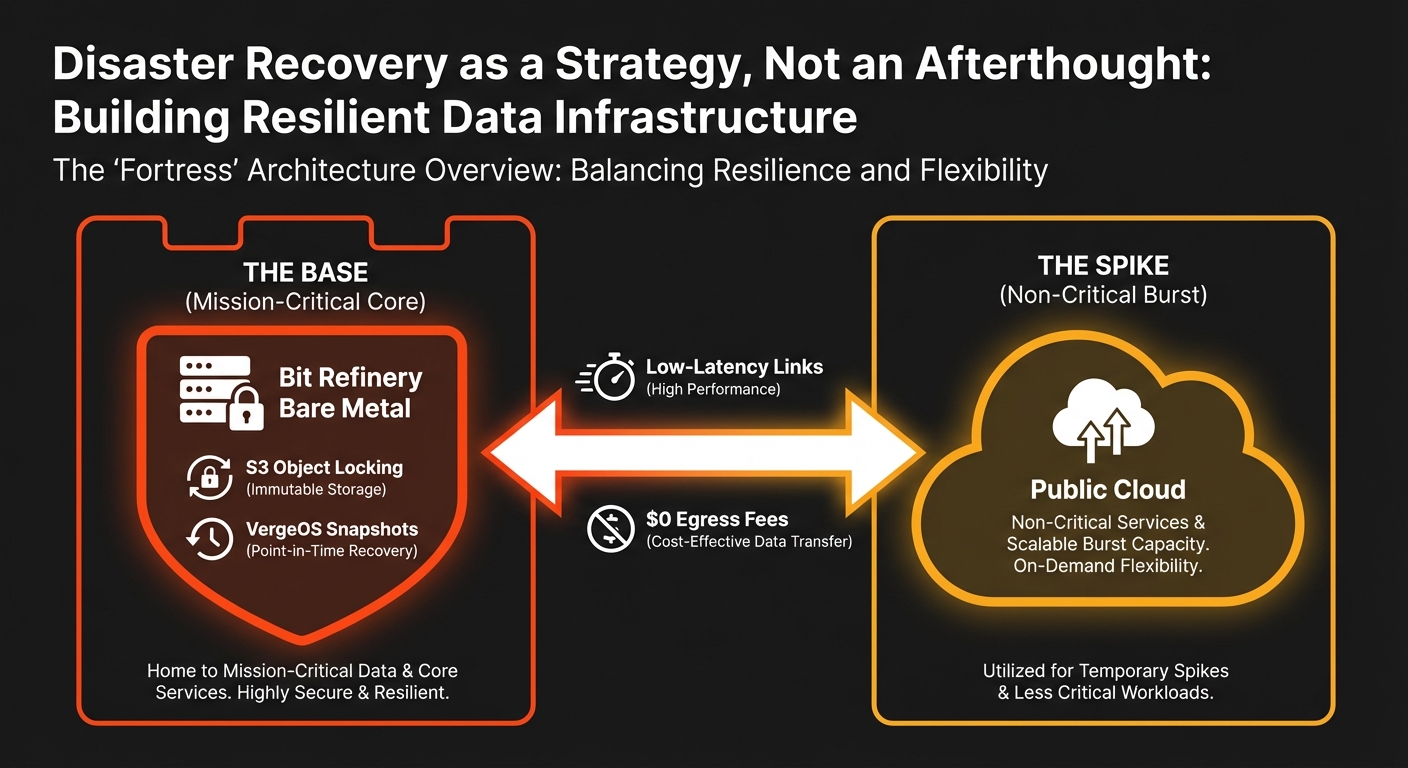
A smart DR strategy often follows our core philosophy: Own the base, rent the spike.
- The Base: Keep your mission-critical data and core services on Bit Refinery bare metal. You get fixed costs, high performance, and total control over your security perimeter.
- The Spike: Use public cloud resources for burst capacity or non-critical dev/test environments.
In this model, Bit Refinery acts as your 'Fortress.' Because we offer sub-2ms latency to major public clouds and $0 egress fees, you can maintain a hybrid posture where your 'Source of Truth' is always protected on dedicated hardware, while still leveraging the broader ecosystem.
The Checklist: Is Your DR a Strategy or a Hope?
If you want to move toward a strategic DR posture, ask your team these three questions:
- Can we afford the exit? If you had to move 100TB of data out of your current provider tomorrow, what would the egress bill be? If the answer is more than your monthly hosting cost, your DR plan is a hostage situation.
- Is the network defined in code? In a failover, reconfiguring IPs and VLANs manually is where most RTOs go to die. Using VergeOS’s software-defined networking, your network topology is part of the snapshot.
- Is our storage immutable? If a bad actor gains admin access to your hypervisor, can they delete your backups? If you aren't using S3 Object Locking on bare metal, the answer is likely yes.
Conclusion
Disaster recovery shouldn't be a manual that sits on a shelf; it should be the foundation upon which your infrastructure is built. By leveraging geo-redundant data centers, immutable object storage, and high-performance bare metal, you can turn 'recovery' into a simple, automated pivot rather than a desperate scramble.
Ready to audit your infrastructure's resilience? Contact the Bit Refinery engineering team to discuss how we can help you build a high-performance, cost-predictable DR strategy on bare metal.