
For modern data engineers, the promise of a "Single Source of Truth" has often felt like a moving target. As organizations scale, data inevitably ends up scattered across S3 buckets, PostgreSQL instances, MongoDB clusters, and legacy on-premises systems.
The traditional solution? Extract, Transform, and Load (ETL) everything into a centralized cloud data warehouse (CDW) like Snowflake or BigQuery. But for many enterprises, this approach has hit a wall of diminishing returns, characterized by skyrocketing storage costs, massive egress fees, and the latency of moving petabytes of data just to run a simple SQL query.
This is where Trino (formerly PrestoSQL) shines—especially when deployed on high-performance bare metal infrastructure. At Bit Refinery, we believe the future of data isn't moving everything to one place; it's querying it where it lives.
The Problem: The "Cloud Data Warehouse Tax"
Centralizing data in the public cloud introduces three primary "taxes" that drain engineering budgets:
- Storage Tax: Paying premium prices for proprietary storage formats within a CDW.
- Egress Tax: The hidden killer. Moving data between regions or out of the cloud provider's ecosystem can cost upwards of $0.09 per GB. For data-intensive workloads, this can easily reach five or six figures monthly.
- Virtualization Overhead: Hyperscale cloud instances often suffer from "noisy neighbors" and CPU stealing, leading to inconsistent query performance for large-scale joins.
Enter Trino: The Federated Query Engine
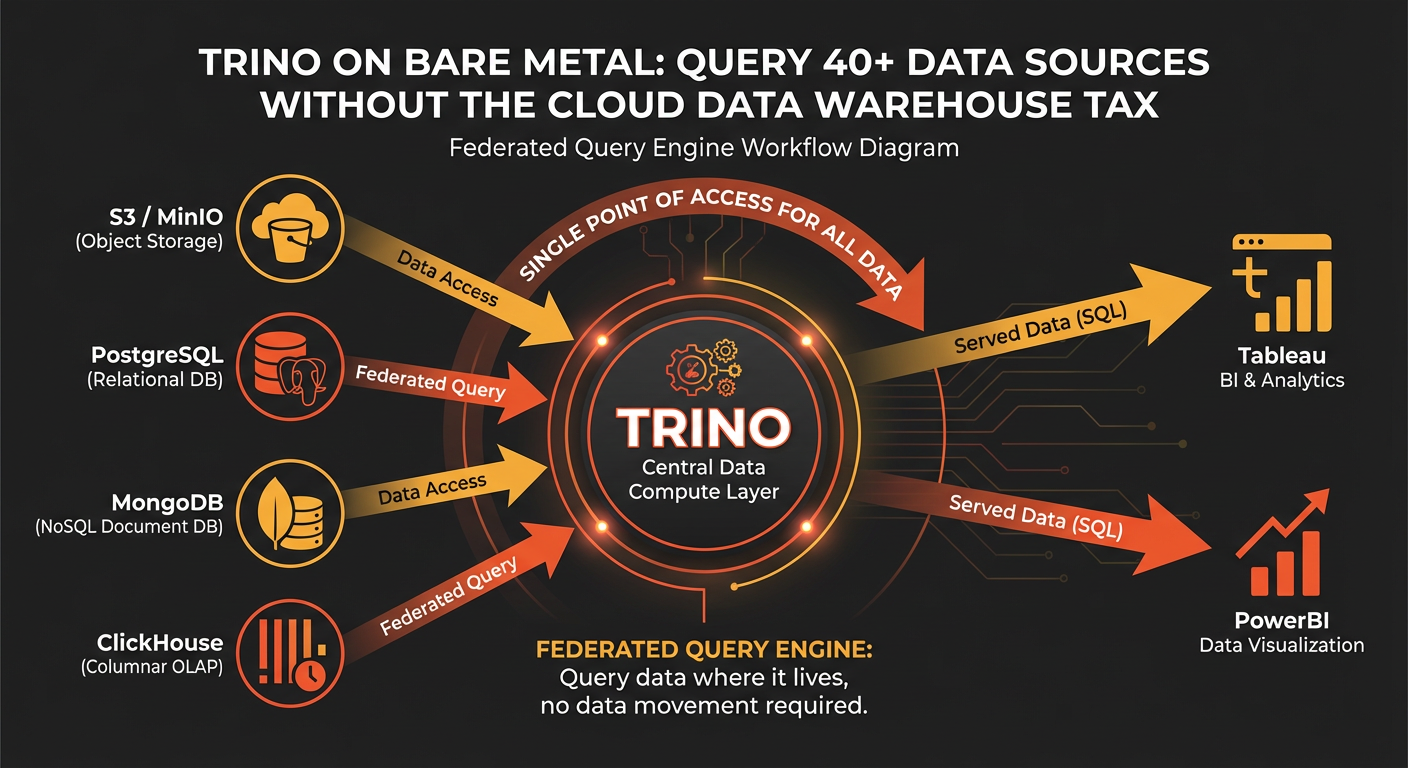
Trino is a highly parallelized, distributed SQL query engine designed for one thing: speed. Unlike a traditional database, Trino does not store data itself. Instead, it acts as a compute layer that connects to over 40 different data sources simultaneously.
You can write a single ANSI SQL query that joins a multi-terabyte table in an S3-compatible bucket (like MinIO) with real-time customer data in a PostgreSQL database and log data in ClickHouse. To the analyst, it looks like one cohesive database.
Why Bare Metal is the Ultimate Foundation for Trino
While Trino is powerful in any environment, running it on Bit Refinery’s bare metal infrastructure provides a performance and cost profile that the public cloud cannot match.
1. Zero Egress Fees
At Bit Refinery, we offer unlimited 1 Gbps bandwidth with $0 egress fees. For a Trino coordinator and its workers, which frequently move large amounts of data across the network during shuffle operations, this predictability is a game-changer. You can query your data across hybrid environments without watching your bill spike every time you run a complex join.
2. Raw CPU and Memory Performance
Trino is an in-memory engine. It requires massive amounts of RAM and high clock-speed CPUs to handle complex aggregations. On a Bit Refinery Gold Tier server, you get 80 cores and 1 TB of RAM. Because there is no hypervisor layer (no VMware or KVM overhead), Trino has direct access to the hardware. This results in significantly lower latency and higher throughput for concurrent users.
3. Predictable Scaling: "Own the Base, Rent the Spike"
Our core philosophy is simple: use dedicated hardware for your baseline analytics needs. A Bit Refinery Platinum node with 3 TB of RAM and 150 TB of NVMe storage costs a flat $4,000/month. A comparable configuration on AWS (such as an r6i.metal instance) would cost over $10,000/month—not including the inevitable data transfer fees.
Use Cases for Trino on Bare Metal
Hybrid Cloud Analytics
Many of our customers keep sensitive data on-premises or in our secure Denver and Seattle facilities while using the public cloud for specific SaaS tools. Trino acts as the bridge, allowing you to query across these environments with sub-2ms latency to major public clouds.
Data Lakehouse Architecture
By pairing Trino with MinIO (S3-compatible object storage) on our bare metal servers, you can build a high-performance Data Lakehouse. You get the flexibility of object storage with the performance of a dedicated SQL engine, all while maintaining full ownership of your data.
Migration from Legacy Warehouses
If you are looking to move away from expensive IBM TM1/Planning Analytics environments or legacy Hadoop clusters, Trino provides a modern SQL interface that integrates with your existing BI tools like Tableau, PowerBI, or Superset.
How Bit Refinery Helps
Setting up and tuning a distributed Trino cluster isn't trivial. It requires careful consideration of worker node sizing, JVM tuning, and connector configurations. Bit Refinery provides Trino Consulting & Managed Services to take the burden off your DevOps team:
- Infrastructure Audits: We analyze your current data stack to identify bottlenecks.
- Performance Tuning: We optimize query execution plans and cluster sizing for your specific workloads.
- 24/7 Monitoring: Our engineers monitor your Trino environment to ensure 99.99% availability.
- Security Integration: We handle SSO integration and fine-grained access control (via Apache Ranger or similar tools).
Conclusion
You don't have to pay the "Cloud Tax" to get enterprise-grade analytics. By leveraging Trino on Bit Refinery’s bare metal infrastructure, you can break down data silos, achieve superior performance, and bring predictability back to your data engineering budget.
Ready to see how much you can save by moving your analytics to bare metal? Contact our engineering team today for a platform assessment.