
For most of our history, our money lived in one place and our books lived in another. Our legacy bank, Vectra Bank, held the cash, QuickBooks held the ledger, and a bank feed (plus a paid accounting consultant) kept the two in rough agreement. In October 2026 we moved our banking to Mercury, on November 1 we started keeping our books in Mercury Books, and we handed the daily bookkeeping to Grok Bot, the AI agent from xAI.
This post covers what we changed, what is still in progress, and what we have learned so far:
- What our old setup looked like and what it cost us
- Why having banking and books behind one API mattered so much
- What Grok Bot does for us and how we work with it
- Where the migration stands, including the part that did not go smoothly
- What daily bookkeeping looks like now, and how our monthly close is set up
- The guardrails we put in place, and who this approach suits
1. Our old setup, and what it cost us
We banked with Vectra Bank and kept our books in QuickBooks Online. On paper this is a normal small business stack, and plenty of companies run it for years without complaint.
In practice the work sat in the gap between the two systems. Every month someone had to:
- fix a bank feed that lagged or dropped transactions
- categorize the transactions the rules missed
- chase receipts for card spend
- match customer payments to invoices
- reconcile the accounts and close the month
We paid an accounting consultant to log in once a month and do most of this, on top of our QuickBooks subscription.
The bank had its own friction. Basic tasks, wire transfers included, often meant a trip to the branch.
2. Why one API for banking and books changes the problem
Mercury already had a well documented API for its banking side: accounts, transactions, cards, recipients and statements. What changed things for us was Mercury Books, its accounting product, which is now available through the same API. That covers the ledger and chart of accounts, journal entries, categorization rules, bills, invoices, tags, the month end close, and reports such as the profit and loss (P&L) statement, balance sheet and cash flow.
With the bank and the ledger on one platform, a transaction does not have to travel between vendors before it can be booked. The record Grok Bot reviews is the same record the bank produced.
| QuickBooks plus legacy Vectra Bank | Mercury banking plus Mercury Books | |
|---|---|---|
| How transactions reach the ledger | Bank feed through a third party aggregator | Native, same platform |
| API coverage | Limited, with gaps such as recurring invoices | One API for banking and books |
| Wires and payments | Often required a branch visit | Done online, with approvals |
| Getting paid by customers | Slower, fewer options | Customers can pay us much more easily |
| Visibility | Split across two systems | Full view of cash and books in one place |
| Cost | Subscription plus a monthly consultant | Significantly less overall |
The API row is the real reason we moved. An agent is only as useful as the systems it can reach, and Mercury gave Grok Bot a single, complete place to work.
3. How Grok Bot works for us
Grok Bot is xAI's agent. We did not build or train anything ourselves. We gave it access to Mercury through the API and told it how we want our books kept.
It works in two ways:
- A weekday check in. Each weekday Grok Bot reviews new transactions in Mercury and in our remaining Vectra Bank account, suggests a category for each one, and flags anything unusual.
- On request. Our VP of operations can ask it questions through the Grok Bot interface, such as "what did we spend on power this month?" or "which invoices are still open?"
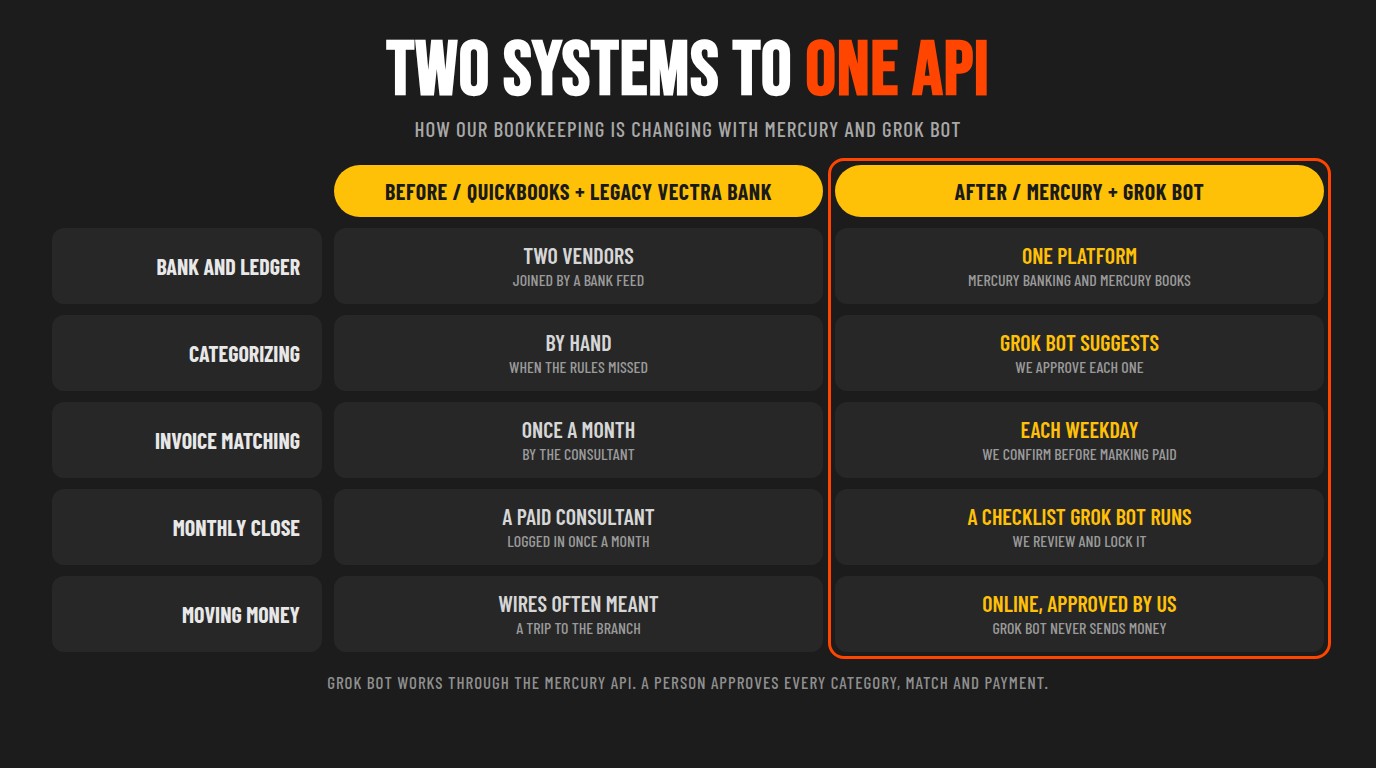
The most important design choice is that Grok Bot suggests and a person decides. Our VP of operations approves every category before it is applied, confirms every invoice match before anything is marked paid, and approves every payment in Mercury. It means nothing lands in our books that a person has not looked at. Section 5 shows why that matters.
4. Where the migration stands
The move is happening in stages, and parts of it are still in progress:
- Banking moved to Mercury in October 2026. Deposits, card spend, wires and new Automated Clearing House (ACH) payments now run through Mercury.
- Vectra Bank stays open for now. We are moving our recurring auto pays to Mercury one at a time, and we will close the Vectra account once the last one has moved.
- Mercury Books started on November 1, 2026, on a cash basis. We kept the Books chart of accounts matching our QuickBooks accounts so reports line up during the transition. Cleaning up the chart of accounts is on the list for later.
- Opening balances are waiting on our accountant. Our certified public accountant (CPA) is reviewing them, and we will finalize them once they sign off.
- QuickBooks is still running. We are keeping it in parallel until our 2026 tax return is filed, and comparing the two systems as we go.
The hardest part so far was getting data out of QuickBooks. Its API is limited, and some things we needed are not available through it at all. Recurring invoices were the clearest example: the API does not list them, so we took screenshots of each one in QuickBooks and had Grok Bot recreate them in Mercury. It worked, but it was slow, manual work of exactly the kind we were trying to leave behind.
5. Daily bookkeeping, now
Here is what happens to a single card transaction today:
- The charge posts in Mercury.
- On its next weekday check in, Grok Bot reviews the charge and suggests a category based on the merchant, the amount, past transactions and any memo.
- It flags anything that looks unusual, such as a new vendor or an amount out of line with past charges.
- Our VP of operations reviews the suggestions and approves them. Only then is the category applied.
Receipt matching is a possible future step, but Grok Bot does not chase receipts or message cardholders today.
Customer payments. Grok Bot matches each incoming deposit to the open invoice it appears to pay and tells us which invoice that is. We confirm the match before anything is marked paid. This check has already caught a mistake. One customer's check looked like it paid their latest invoice, but the remittance memo showed it actually paid an older invoice that was still open. Because a person checked the match first, we caught it before the books were wrong.
Paying vendors. Grok Bot never sends money. When a vendor invoice arrived recently, Grok Bot set up the vendor and a payment request in Mercury. Our VP of operations approved the payment in Mercury, and it posted to the right expense account.
The result is that the books are kept current through the month, not just once a month when the consultant logged in.
6. How our monthly close is set up
Our first close in Mercury Books, for November, happens in early December 2026, so this describes how the close is set up to work rather than a routine we have run many times. Grok Bot will run the close as a checklist:
- Reconcile every account against its statement
- Clear or escalate every uncategorized transaction
- Post recurring journal entries
- Compare this month's P&L and balance sheet with the previous month and flag anything that moved more than we would expect
- Prepare a short summary of the month for review
Our VP of operations will review that summary and the exceptions, make any corrections, and only then lock the period. Because categories and invoice matches are approved as we go, we expect most of the close to be review rather than catch up work.
7. Guardrails and controls
Giving an agent access to your books is a reasonable thing to be cautious about. These are the rules we set:
- It does not move money. Grok Bot can set up vendors and payment requests, but every payment is approved by a person in Mercury.
- Categories need approval. Grok Bot suggests a category for each transaction, and nothing is applied until our VP of operations approves it.
- Invoice matches need approval. Grok Bot proposes which invoice a payment belongs to, and we confirm before anything is marked paid.
- A person signs off the close. Grok Bot prepares the close, and our VP of operations approves it.
- A CPA still checks the books. Our CPA reviews our opening balances and our books at tax time.
We no longer pay for monthly data entry. We are the human in the loop for every category, invoice match and payment, which takes far less time than the old process and keeps the decisions with us.
8. What we have learned so far
If you are thinking about something similar, a few lessons from our move:
- Check the API before you choose any software. QuickBooks' gaps have cost us the most time in this migration. We now weigh API coverage heavily for every tool we pick, since an agent can only work with what it can reach.
- Keep your chart of accounts the same during the switch. Matching accounts makes it much easier to compare the old and new systems while both are running. Cleanup can wait until the old system is retired.
- Make human approval part of the design. Having a person approve categories, matches and payments is what lets us trust the agent with real books. The misapplied check payment would have slipped through without it.
- Run in parallel longer than you think you need. We are keeping QuickBooks until our tax return is filed, so we always have the old books to compare against.
- Move in stages. Banking first, then books, then recurring payments, with the old bank open until the last auto pay has moved.
This approach suits most small and mid sized companies with fairly simple books: one entity, mostly card, ACH and wire activity, and a manageable number of vendors and customers. If you run multiple entities, carry inventory, or have complex revenue recognition, expect more human work and more custom rules, at least for now.
Closing thoughts
Moving our banking and accounting to Mercury, and handing the routine work to Grok Bot, costs us significantly less than our old setup and keeps our books current through the month. We still make every decision that matters, from approving categories and payments to locking the books, and we no longer spend time copying numbers between systems.
We are happy to share more about how we set this up with teams thinking about the same move. If that sounds useful, get in touch.